Кончится лето
In a recent meeting, conducted at high speed on the motorway, a somewhat apoplectic NATO officer, furious at the lacklustre response to recent Russian activities within Western Europe, asked me, “How should we deal with Russia?”
My response was simply: “Fracture.”
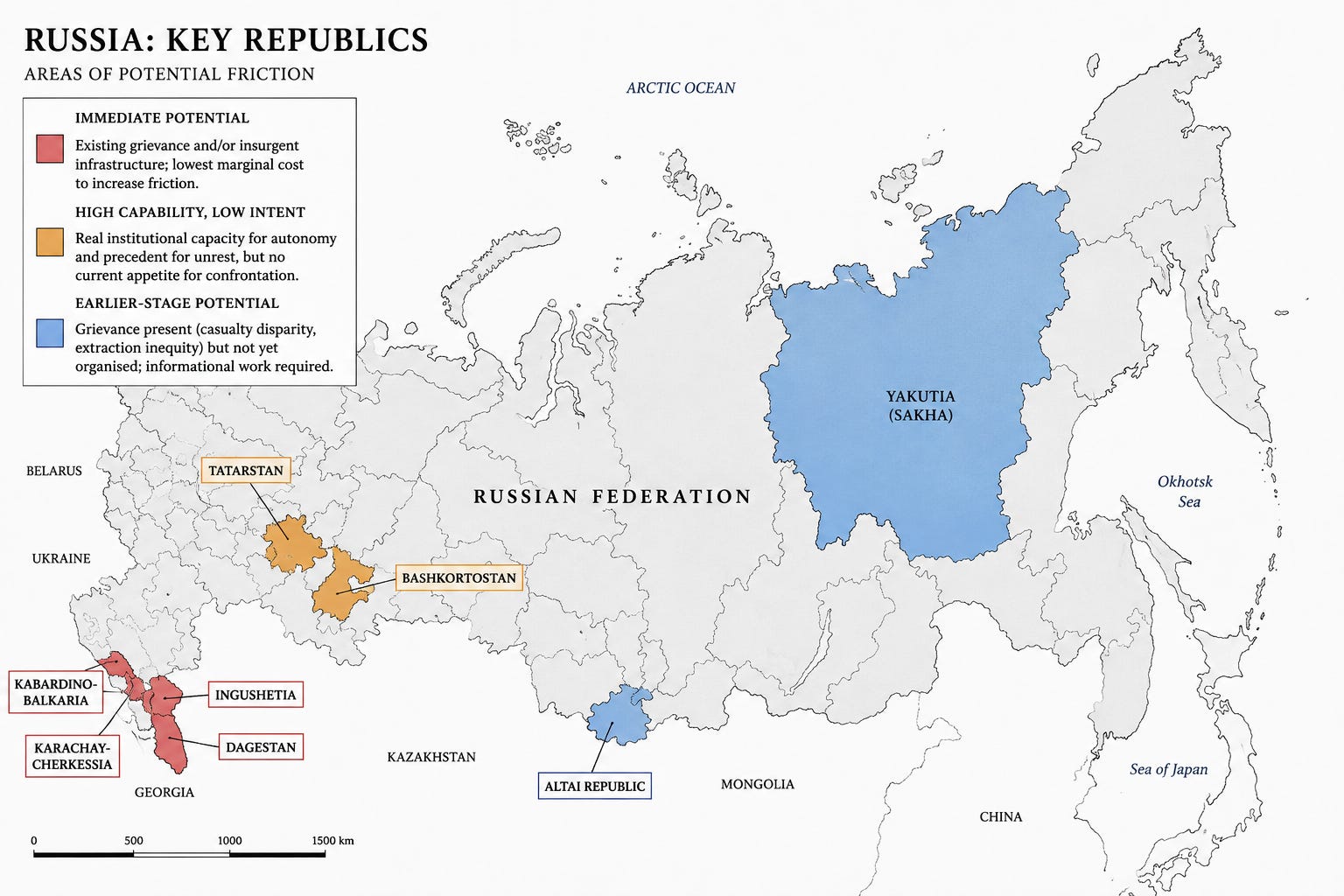
Republics such as Ingushetia, Dagestan, Kabardino-Balkaria[1], Karachay-Cherkessia[2], Yakutia[3], and the Altai Republic[4] have the necessary potential, with some differences, to be used for this. Tatarstan and Bashkortostan[5] are a further tier of high capability but currently low intent.
The underlying premise is simple. Russia’s external capacity is conditional upon internal coherence. Pressure applied where Moscow chooses to project power addresses only the symptom. Pressure applied to the coherence that makes projection possible addresses the condition itself.[6] [7] [8] [9] [10]
The mechanism differs by case. Ingushetia[11] and Dagestan[12] already carry active insurgent infrastructure rather than merely latent grievance. The marginal threshold for increasing friction there is therefore lowest. From Ingushetia, a spillover effect into North Ossetia would be useful, for instance. Such a development would create a second front along the Prigorodny fault line and force Moscow to divert security attention from the Caucasus periphery to a republic it currently treats as reliable. Yakutia and Altai are earlier-stage cases, where grievances around casualty disparity and extraction inequity are present but not yet organised; here the work is informational rather than material[13]. Tatarstan and Bashkortostan sit apart: both have real institutional capacity for autonomy and, in Bashkortostan’s case, a recent precedent of open unrest, but neither shows current appetite for confrontation. Any effort there is long-horizon, aimed at intent rather than capability.
Direct containment is not pointless. Ukraine has shown that it destroys equipment, personnel, and capacity, denies objectives, and imposes real opportunity cost. Its limitation is structural rather than tactical: it attacks the manifestations of Russian power while leaving the political-territorial apparatus that regenerates that power largely intact. Internal fracture attacks the apparatus itself, and Ukraine’s cost imposition is precisely what makes that apparatus worth pressuring now. Operation Cyclone offers the obvious historical analogy. Afghanistan helped disrupt and weaken the Soviet system by making an existing liability progressively more expensive. It also produced consequences nobody controlled, which is less an objection to the analogy than a warning against misunderstanding it. The mentality governing Moscow has changed considerably less than the map has.
Sustained internal pressure would not need to threaten Moscow’s active measures in North America or the European Union to be worthwhile. It would rob those operations of potency and focus, which is sufficient. A Kremlin managing a live insurgency in the Caucasus and separatist sentiment in Siberia has less institutional bandwidth for expeditionary political warfare abroad. Collapse would merely be an unnecessary excess.[14] [15]
The relevant question is not whether externally encouraged friction produces uncontrollable consequences. It will. The question is whether those consequences fall more heavily, and more persistently, on the Russian centre than on those applying the pressure. The wager is geographic. Disorder need not remain inside Russia’s borders to be useful; it merely needs to remain considerably more expensive for Moscow than for us. Some spillover is inevitable. The exposure to us nevertheless remains manageable, and it is worth being precise about what “manageable” rests on: Moscow already runs comparable operations against European cohesion, through the Reichsbürger movement in Germany and through disruption efforts aimed at Slovakia, Hungary, Croatia, and Austria. Should we increase our own activity, Russian retaliation may intensify in kind or in tempo, but we would be meeting a familiar threat knowingly rather than merely absorbing it. That asymmetry favours us. [15] [16] [17] [18] [19] [20] [21]
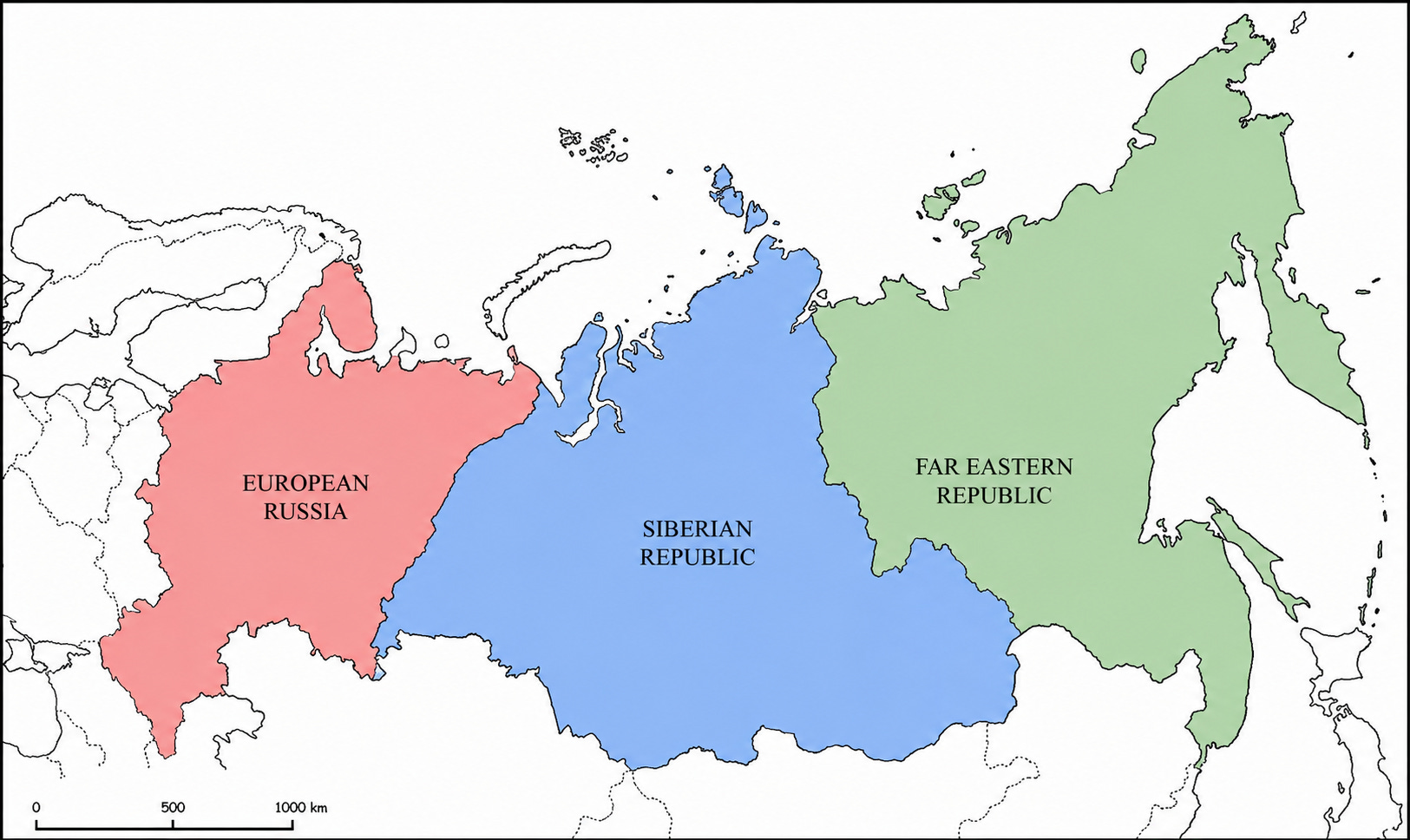
The operational sequence runs from micro to macro. Energising the smaller republics is the working level: real, local, deniable friction, applied where grievance already exists rather than manufactured from nothing. European Russia, a Siberian Republic, and a Far Eastern Republic represent the macro logic at the outer edge of this process. They are useful as a map of what Moscow might fear, not as a map of what we should wish to inherit. Three successor authorities would in all likelihood be more totalitarian, albeit more inward-facing, than the one they replaced, and of little use to us for at least a generation.
What we want is Moscow persistently occupied with the possibility, spending resources to prevent an outcome it fears rather than an outcome we are trying to produce. Moscow’s obvious response would be greater repression and centralisation. This does not defeat the mechanism. If additional surveillance, security deployments, elite management, and political repression are required to keep the periphery quiet, the centre is already paying part of the intended cost. More importantly, this creates the possibility of a reflexive control measure against Moscow: its predictable attempt to suppress internal discord may deepen that discord once established, while simultaneously consuming the resources required to contain it. The relevant measure is not simply the unrest produced, but the resources Moscow must continually expend to prevent unrest from becoming something larger and, ultimately, unruly. [22]
There is no requirement for these pressures to resolve themselves. Russia has long understood the strategic utility of frozen conflicts: disputes kept below the threshold of decisive escalation (for instance, salami tactics), yet sufficiently alive to constrain the states around them. The same principle can be turned inward. An unresolved internal conflict can impose continuing political and security costs on Moscow without ever producing secession. Fragmentation is not the objective. Its value lies in remaining within Moscow’s field of plausible outcomes: distant enough not to become inevitable, credible enough that it cannot safely be ignored. This is not a precise instrument, and it should not be sold as one; the value is in sustained direction, not in calibrated control.
Control, in fact, should not be assumed as a requirement at any stage. What matters is the distribution of the disorder we enable, not our command over it.
A further secondary benefit is worth stating plainly rather than leaving implicit. An anti-hegemonic bloc of China, Russia, and Iran, with North Korea drifting into de facto vassalage and Beijing as its political centre, depends on Moscow being available as a functioning partner. A Russia absorbed by its own internal management is a materially weaker and less useful partner in that structure. Friction inside the Federation is therefore not only a Russia policy; it is a constraint on bloc consolidation more broadly.
None of this can be run with a heavy hand. Visible external fingerprints hand Moscow precisely the unifying narrative it already reaches for when ethnic-republic unrest surfaces: chaos, collapse, civil war, rally around the centre. Deniability is not insulation. Moscow may retaliate on suspicion alone; what matters is denying it an unnecessarily persuasive case that the disorder is foreign-made. This requires small, specialised resources and a particular kind of person, operating with restraint. Europe has both the capability and the cultural fluency for this work. The resources are largely already available to us. What has been lacking is not capability, but disposition.
-j
(20260901)
References:
[1] The Kabardino-Balkaria Insurgency: A Comparative Analysis of Ideological Trends in the North Caucasus, Sufian Zhemukhov and Jean-François Ratelle, PONARS Eurasia Policy Memo No. 156, 2011. https://www.ponarseurasia.org/wp-content/uploads/attachments/pepm_156.pdf
[2] Karachay-Cherkessia: A Forgotten Republic Grappling with Identity, Poverty, and Russian Dominance, Noon Post, NoonPost English, 2025. https://english.noonpost.com/p/karachay-cherkessia-a-forgotten-republic
[3] Massive Crackdown: Russian Authorities Crush Separatist Coup, RFU News, RFU News, 2026. https://www.rfunews.com/articles/massive-crackdown-russian-authorities-crush-separatist-coup
[4] Russian Separatism Problem: The Protest Movement in the Republic of Altai, Velvl Chernin, Begin-Sadat Center for Strategic Studies, 2025. https://besacenter.org/russian-separatism-problem-the-protest-movement-in-the-republic-of-altai/
[5] Bashkortostan: An Exploration of Protest Potential During Wartime, Jana Paegle and Pär Gustafsson Kurki, Swedish Defence Research Agency (FOI), FOI Memo 8645, 2024.
https://www.foi.se/rest-api/report/FOI%20Memo%208645
[6] Elite Cohesion and Resilience of the Russian Regions: The Case of Belgorod Oblast, Ekaterina Paustyan, Post-Soviet Affairs, Vol. 40, 2024, pp. 296–312. DOI: 10.1080/1060586X.2024.2354940. https://www.tandfonline.com/doi/full/10.1080/1060586X.2024.2354940
[7] Assessing the Strength and Stability of the Russian Regime, Marina Ohanjanyan, Niels Drost, Kaspar Pucek and Bob Deen, Clingendael Institute, 2026. https://www.clingendael.org/publication/assessing-strength-and-stability-russian-regime
[8] The Russia Stability Tracker, Andrea Kendall-Taylor, Center for a New American Security (CNAS), 2023. https://www.cnas.org/publications/reports/the-russia-stability-tracker-nov23
[9] (Book) Vodka Politics: Alcohol, Autocracy, and the Secret History of the Russian State, Mark Lawrence Schrad, 2014. ISBN 9780199755592.
[10] Support for Separatism in Ethnic Republics of the Russian Federation, Louk Hagendoorn, Edwin Poppe and Anca Minescu, Europe-Asia Studies, Vol. 60, No. 3, 2008, pp. 353–373. DOI: 10.1080/09668130801947960.
https://www.tandfonline.com/doi/full/10.1080/09668130801947960
[11] FSB’s Counter-Terrorism Operation in Ingushetia, Tactics Institute for Security and Counter-Terrorism, 2024. https://tacticsinstitute.com/eurasia/fsbs-counter-terrorism-operation-in-ingushetia/
[12] What Is Known About the Attacks in Russia’s Dagestan?, Guy Faulconbridge and Felix Light, Reuters, 2024. https://www.reuters.com/world/europe/what-is-known-about-attacks-russias-dagestan-2024-06-24/
[13] (Book) FM 3-05.30/MCRP 3.40.6 Psychological Operations, US Army, 2005. http://www.fas.org/irp/doddir/army/fm3-05-30.pdf
[14] Why Didn’t the Russian Federation Fall Apart in 1991?, Boris N. Mironov, Social Sciences, Vol. 55, No. 1, 2024, pp. 96–120. https://pureportal.spbu.ru/ru/publications/why-didnt-the-russian-federation-fall-apart-in-1991%28230451d4-0dfc-44d1-8cd2-887b05612ef1%29.html
[15] PSYOPS Warfare in 21st Century: Visualizing Crash and Cure, Rana Danish Nisar, World Geostrategic Insights, 2024. https://www.wgi.world/psyops-warfare-in-21st-century-visualizing-crash-and-cure/
[16] Theorizing Psychological Operations Through Norm Entrepreneurship: The Cases of Radio Free Europe and Radio Liberty, Sevsu Önder, Uluslararası İlişkiler / International Relations, Vol. 22, No. 86, 2025, pp. 67–86. DOI: 10.33458/uidergisi.1665792.
https://dergipark.org.tr/en/download/article-file/4726398
[17] Intelligence: Covert Action, CFR Education, Council on Foreign Relations. https://www.cfr.org/education/teach/simulations/intelligence-covert-action
[18] (Book) Covert Regime Change: America’s Secret Cold War, Lindsey A. O’Rourke, 2018. ISBN 9781501730658.
[19] (Book) Coup d’État: A Practical Handbook, Revised Edition, Edward N. Luttwak, 2016. ISBN 9780674969674.
[20] The December 2022 German Reichsbürger Plot to Overthrow the German Government, Alexander Ritzmann, CTC Sentinel, Combating Terrorism Center at West Point, Vol. 16, Issue 3, 2023. https://ctc.westpoint.edu/?p=52450
[21] (Book) Austria Behind the Mask: Politics of a Nation since 1945, Paul Lendvai, 2023. ISBN 9781805260592.
[22] Politics as the Continuation of Conflict: Messner, Managed Instability, and the Russian Understanding of War, John Sjoholm, Substack, 2026. https://johnsjoholm.substack.com/p/politics-as-the-continuation-of-conflict
[x] Human suffering scales efficiently when it is managed, John Sjoholm, Substack, 2025. https://johnsjoholm.substack.com/p/202512281-weaponisation-of-the-suffering
[x] Ethnic Trends in Contemporary Russia: Are There Demographic Prerequisites for Separatism and Breakup?, Vasily Bublikov, Nationalities Papers, 2026, pp. 1–32. DOI: 10.1017/nps.2026.10152.
https://www.cambridge.org/core/journals/nationalities-papers/article/ethnic-trends-in-contemporary-russia-are-there-demographic-prerequisites-for-separatism-and-breakup/
[x] Comparative Ethnic Territorially Based Autonomy in Tatarstan, Bashkortostan, and Yakutia of Russia: An Analytical Framework, Sansar Tsakhirmaa, Nationalities Papers, Vol. 48, No. 5, 2020, pp. 891–914. DOI: 10.1017/nps.2019.77.
https://www.cambridge.org/core/journals/nationalities-papers/article/abs/comparative-ethnic-territorially-based-autonomy-in-tatarstan-bashkortostan-and-yakutia-of-russia-an-analytical-framework/
[x] (Book) The Old Boys: The American Elite and the Origins of the CIA, Burton Hersh, 1992. ISBN 9780684193489.
[x] (Book) The Ugly American, William J. Lederer and Eugene Burdick, 1958. ISBN not applicable to the original 1958 edition; later Norton edition ISBN 9780393318678.
[x] (Book) Edward Lansdale’s Cold War, Jonathan Nashel, 2005. ISBN 9781558494640.
[x] (Book) Edward Lansdale: The Unquiet American, Cecil B. Currey, 1988. ISBN 9780395385104.
[x] (Book) In the Midst of Wars: An American’s Mission to Southeast Asia, Edward Geary Lansdale, 1972. ISBN 9780060125103.
[x] (Book) The Grand Chessboard, Zbigniew Brzezinski, 1997. ISBN: 0465027253.
John Sjoholm, for LIMA CHARLIE WORLD
[Subscribe to our newsletter for free and be the first to get Lima Charlie World updates delivered right to your inbox.]
John Sjoholm is Lima Charlie’s Middle East Bureau Chief, Managing Editor, and founder of the consulting firm Erudite Group. A seasoned expert on the Middle East, North Africa, Europe and the Balkans, he has a background in security contracting and has served as a geopolitical advisor to regional leaders. He was educated in religion and languages in Sana’a, Yemen, and Cairo, Egypt, and has lived in the region since 2005, contributing to numerous Western-supported stabilisation projects. He currently resides in Jordan.
Lima Charlie World provides global news, featuring insight & analysis by military veterans, intelligence professionals and foreign policy experts Worldwide.
For up-to-date news, please follow us on twitter at @LimaCharlieNews
In case you missed it: