States Are Not Supposed to Retreat From Themselves
[Originally published May 8, 2026] This text was originally supposed to go out on 7 May 2026, marking the anniversary of the 2008 Lebanon conflict. Assignment prevented that. I have been largely radio silent over the past month due to several time-consuming projects, including two ongoing book projects and preparations for an upcoming lecture in Poland later this week. Before returning to some of the larger ongoing analyses, however, it is worth revisiting the 2008 Lebanon conflict briefly, particularly given how poorly it continues to be understood in Western strategic discourse.
This piece should also be read alongside my earlier Lebanon framework paper, Beirut and the Polycentric Reality, which examines Hezbollah less as a discrete military organisation and more as an embedded governance ecosystem operating within Lebanon’s fragmented and polycentric state structure.[1]
The 2008 Lebanon conflict continues to be misunderstood in much of Western discourse as a confrontation between a sovereign state and a non-state militia. This framing obscures the operational realities visible at the time. The conflict was not fundamentally about a state suppressing an external armed actor, but about a fragmented formal state structure confronting an internally coherent hybrid sovereignty ecosystem that had already acquired substantial operational autonomy inside Lebanon itself.
CORE ASSESSMENTS
- The 2008 conflict was not primarily a confrontation between a state and a militia, but between a fragmented formal state structure and an internally coherent hybrid sovereignty ecosystem operating inside the same territorial framework.
- Hezbollah’s telecommunications network functioned as sovereign infrastructure essential to operational continuity, force projection, and strategic survivability. [2][3]
- The Lebanese Armed Forces’ refusal to decisively confront Hezbollah demonstrated the divergence between formal sovereignty and operational sovereignty inside Lebanon. [4]
- The Doha Agreement reflected not reconciliation, but a realpolitik accommodation between overlapping coercive and governance ecosystems. [5]
STRATEGIC IMPLICATIONS
- Embedded hybrid governance actors cannot be removed sustainably without replacement structures capable of providing security, continuity, and service provision.
- Formal sovereignty alone does not guarantee operational control inside fragmented political environments.
- Attempts to dismantle embedded governance ecosystems without replacement capacity risk accelerating fragmentation rather than restoring central authority.
- Durable influence in fragmented systems accrues to actors capable of combining coercive credibility with governance continuity.
The principal actors in the conflict reflected Lebanon’s fragmentation clearly. Hezbollah and Amal confronted a loose anti-Syrian governing coalition centred around the Future Movement, elements aligned with the Lebanese Forces, Druze formations associated with the Progressive Socialist Party, and various affiliated Sunni and local armed networks operating underneath the formal umbrella of the Lebanese state. The confrontation was therefore not a coherent state suppressing an external militia. It was a struggle between competing governance and coercive structures operating inside the same territorial framework.
The immediate trigger was the Lebanese government’s decision to dismantle Hezbollah’s independent fibre-optic telecommunications network and remove Beirut airport’s head of security, who was considered sympathetic to Hezbollah. Beirut approached the matter as a question of legality and sovereign authority. Hezbollah understood it differently. Hassan Nasrallah explicitly stated that the network was “integral and fundamental” to Hezbollah’s military apparatus and that interference with it would constitute a declaration of war. [2][6]
This reaction only appears disproportionate if Hezbollah is viewed as a militia subordinate to the Lebanese state. By 2008, Hezbollah had already evolved into something far more structurally embedded: a parallel sovereignty ecosystem operating inside Lebanon itself.
The American diplomatic cable later published through WikiLeaks unintentionally described this reality with unusual clarity. Lebanese officials explained to the US Embassy that Hezbollah now possessed “an army and weapons; a television station; an education system; hospitals; social services; a financial system; and a telecommunications system.” [2] This was not a description of an insurgent faction operating from the margins of the state. It was the operational architecture of statehood being constructed inside the shell of another state.
This distinction mattered because formal sovereignty and operational sovereignty had already diverged. Beirut retained international recognition, ministries, diplomacy, and procedural legitimacy. Hezbollah possessed resilient communications infrastructure, territorial penetration, intelligence capability, welfare systems, escalation dominance, and the ability to project force inside its sphere of influence. One actor possessed legal sovereignty. The other possessed operational sovereignty.
The fibre-optic network itself was central to this ecosystem. It was not merely telecommunications infrastructure, but protected command-and-control capability, operational continuity, intelligence survivability, and strategic resilience independent from the Lebanese state. Beirut attempted to apply the procedural logic of a monopoly state to an environment that had long ceased functioning monopolistically. Hezbollah responded by operating according to the realities that actually existed.
States Are Not Supposed to Retreat From Themselves
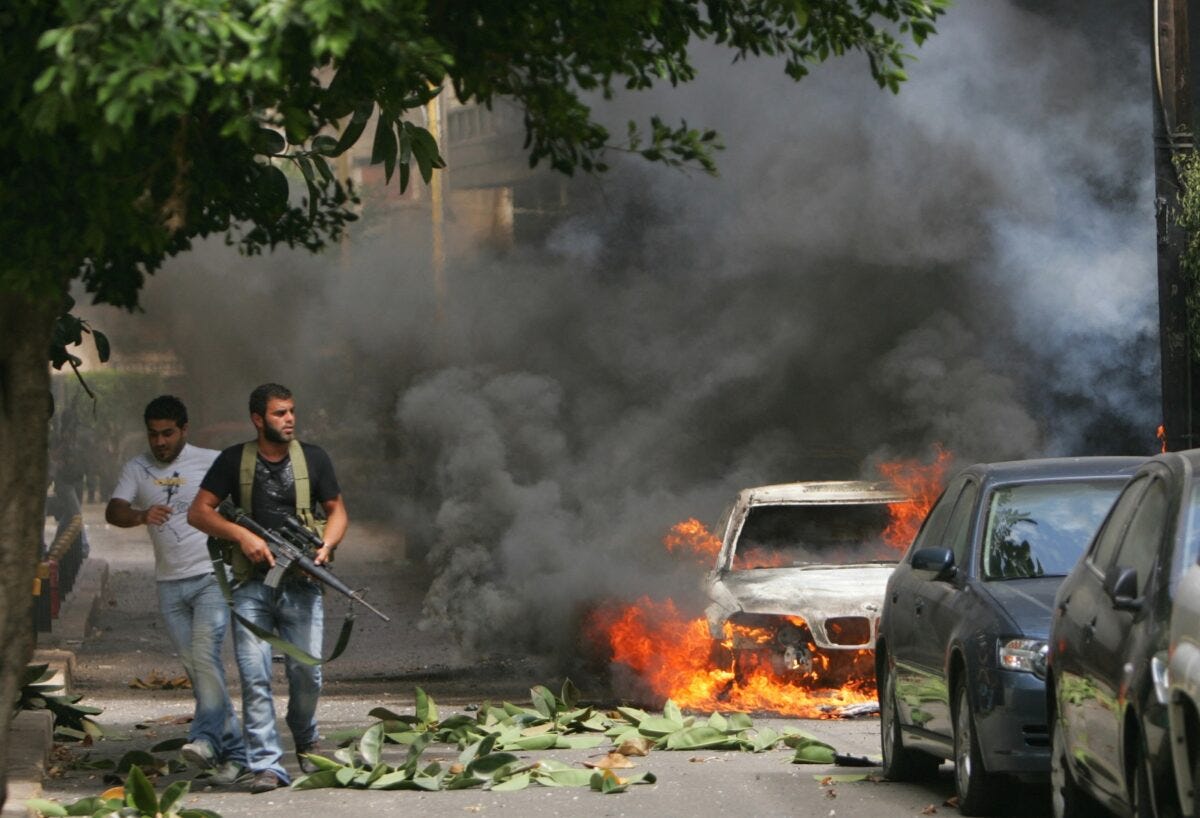
The response was immediate and decisive. Hezbollah fighters rapidly moved into West Beirut, overwhelmed Future Movement-aligned Sunni militias and other pro-government armed networks, shut down hostile media infrastructure, and forced the Lebanese state into open retreat inside its own capital. Beirut could neither enforce its decision nor secure the infrastructure through which it claimed authority. [3][4]
More importantly, the Lebanese Armed Forces largely refused decisive confrontation with Hezbollah, fearing internal fragmentation and institutional collapse if the army itself fractured along sectarian lines. [4] This was an extraordinarily important signal. Armies are instruments through which states enforce sovereignty. An army unwilling to enforce a sovereign decision due to anticipated collapse risk has already recognised the operational dominance of the opposing actor.
The Lebanese Armed Forces chose institutional survival over procedural legality because they understood the likely consequence of escalation. A direct confrontation risked not merely military defeat, but systemic fragmentation and the collapse of the remaining state framework. In practice, the Lebanese state judged coexistence with Hezbollah less dangerous than the vacuum likely to emerge from attempting to dismantle it by force.
The subsequent Doha Agreement reflected this reality. It was not a conventional peace settlement so much as a realpolitik boundary adjustment between overlapping sovereignties. Hezbollah retained its weapons, preserved its communications infrastructure, and secured greater political leverage inside the Lebanese system. [5] The state attempted to dismantle Hezbollah’s strategic infrastructure, failed, and subsequently accommodated the reality it lacked the capacity to remove.
The conflict also exposed the extent to which Lebanon’s formal state structure had already become dependent on fragmented sectarian and political-security networks of its own. Hezbollah was not confronting a coherent, functional, much less actualised monopoly state, but a competing landscape of weaker patronage-based armed structures operating underneath the procedural shell of Beirut itself.
This deeper inversion mattered. Hezbollah did not behave as a fragmented non-state actor confronting a coherent centralised state. The opposite had become true. Hezbollah operated as a disciplined and internally coherent sovereignty ecosystem, while the formal Lebanese state functioned as a fragmented procedural shell lacking unified operational capacity.
This distinction matters because authority gradually migrates toward the actor capable of maintaining continuity, protection, infrastructure, service provision, and escalation dominance. International recognition alone does not guarantee operational sovereignty. States may retain flags, ministries, treaties, and diplomatic legitimacy long after meaningful authority has partially migrated elsewhere.
Lebanon demonstrated this reality with unusual clarity once such structures became sufficiently embedded. The strategic problem was no longer how to eliminate the actor outright through procedural or purely military means, but how to manage coexistence, containment, integration, or gradual reshaping without triggering wider systemic collapse.
That was the reality Lebanon confronted in 2008, and it remains a reality many external actors continue to misunderstand today. The lessons extend well beyond Lebanon itself, demonstrating how formal sovereignty, procedural authority, and operational power can diverge inside fragmented political environments, and why external actors repeatedly misunderstand how states such as Lebanon actually function under conditions of embedded parallel authority.
John Sjoholm, for LIMA CHARLIE WORLD
[Subscribe to our newsletter for free and be the first to get Lima Charlie World updates delivered right to your inbox.]
John Sjoholm is Lima Charlie’s Middle East Bureau Chief, Managing Editor, and founder of the consulting firm Erudite Group. A seasoned expert on the Middle East, North Africa, Europe and the Balkans, he has a background in security contracting and has served as a geopolitical advisor to regional leaders. He was educated in religion and languages in Sana’a, Yemen, and Cairo, Egypt, and has lived in the region since 2005, contributing to numerous Western-supported stabilisation projects. He currently resides in Jordan.
Lima Charlie World provides global news, featuring insight & analysis by military veterans, intelligence professionals and foreign policy experts Worldwide.
For up-to-date news, please follow us on twitter at @LimaCharlieNews
In case you missed it: