I was watching a few youtube documentaries the other day. The first [1] was about the various Soviet supercomputers, and the second [2] was about the creation of the Setun, the world’s first ternary computer, and the life of its creator Nikolai Brusentsov. Setun was designed around balanced ternary logic (−1, 0, +1) instead of conventional binary.
This supposedly made the Setun smaller, more efficient, and surprisingly powerful. This all reminded me of a short science fiction story that I read as a teenager, sitting in the school library. It appeared in one of the many anthologies assembled by the Swedish science fiction legend Sam J. Lundwall. I have a vague recollection that the author of the story may have been Hungarian or Czech, but I have not had much luck tracking the story down.
As I remember it, the story went something like this:
The protagonist is an academic, a mathematician if my memory serves me right. One day he reads in the newspaper that a new company has opened in town. The company claims to possess a remarkable computer, one that will answer questions in exchange for payment.
Curious, he visits the company and submits a mathematical problem. He is told to return the following day. At least I think it was the following day. In any case, when he returns, he receives the answer.
The answer is perfect.
Impressed, he returns within a few days with a more difficult problem.
Again, the answer is perfect.
But he also begins to wonder about the machine itself. He has never actually seen a large computer before and asks if he may see it. He is promptly shown the door.
Undeterred, he returns with another problem. Once again the answer is flawless. Yet something begins to bother him. The answer seems almost human. Not wrong. Not imperfect. Oddly human. I no longer remember exactly what led him to that conclusion, only that he became increasingly convinced that there was a person behind the answers rather than a machine.
He continues testing the system.
Each answer reinforces his suspicion
Eventually he devises a problem that somehow allows a reply to be hidden within the mathematics itself. Do not ask me how this worked; I have forgotten. But the reply he receives confirms what he already suspects.
There is a human being answering the questions.
He returns to the company and confronts them. He announces that he knows the truth and that he intends to return with the police.
Instead, he is invited inside.
There he discovers that the company is not a company at all, but a prison. Highly intelligent people are confined there and forced to function as human computers. As I recall, they are drugged and worked until they burn out, after which they are discarded as waste and replaced.
The ending, however, I remember perfectly.
There never was a machine.
There were only people.
The short story came back to me when I first read John Searle’s thought experiment known as the Chinese Room [3]. It is a near inversion of the idea. Today we worry about machines appearing too human, imitating humanity too well. Here, human beings are forced to be a machine.
There is also a broader social theme running through it, at least as I remember it. Human beings reduced to cogs within a machine, valued only for their ability to perform and then discarded as waste when they fail. Whether the original author intended this as a criticism of capitalism, socialism, or simply modernity, I cannot say. No wonder I enjoyed the story as a 12–13-year-old.
The protagonist discovers, through an inverse Turing test, that the machine is human. The notion of us as the machine, within the machine, has remained with me ever since. If the story were written today, one might perhaps call it “Artificial Artificial Intelligence”.
So, on the off chance that this plot sounds familiar to someone, do let me know. Most people I have asked about this have suggested that I use AI to find a solution. The irony was not lost on me. I tried, but received a great many hallucinated answers of little value.
-j
(20260619)
P.S. I found Sam J. Lundwall’s postal address online and have been pondering sending him a letter to ask about this. This strikes me as charmingly old-fashioned and faintly unhinged. I am certain the AAI would approve. But I do not suppose anyone would happen to have his email address instead?
P.P.S. More than twenty years ago I read the book “The Supermen: The Story of Seymour Cray and the Technical Wizards Behind the Supercomputer” (ISBN: 978-0471048855) by Charles J. Murray. Flipping through it again today, it remains a solid read.
P.P.P.S. One can’t help but wonder if idle meandering thoughts have value in this format, published here on Substack. I have previously only posted such things on Facebook – but really, one feels a need to stop being active on that platform.
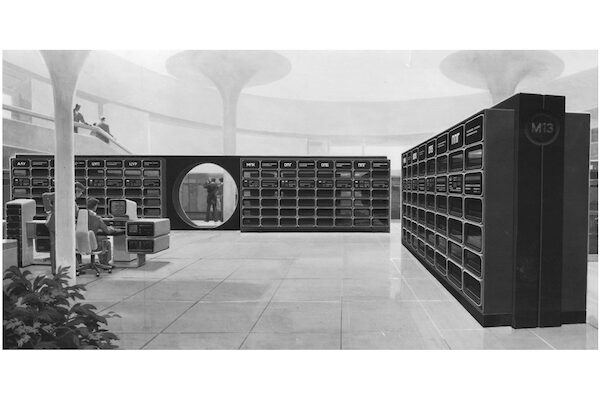
P.P.P.P.S. For this post I used an illustration from 1984 of the Soviet supercomputer M-13. The M-13 [4], classified in Soviet parlance not as a supercomputer, a Western term, but as an ЭВМ, an electronic calculating machine, it seems pleasantly innocent and somewhat too small to house all that many humans, even if they are midgets. With that said, the M-13 was installed and put into operation in Moscow in 1984. The illustration shows the M-13 installation in Moscow. The system was designed for vector calculations and calculations involving complex numbers, achieving approximately 2.4 GFLOPS, making it the first computer system to surpass the 1 GFLOP threshold. It was the world’s fastest “supercomputer” between 1984 and 1985 and remained, until November 2010, the only supercomputer installation outside the United States or Japan ever to hold the number one position.
P.P.P.P.P.S The M-13’s 2.4 GFLOPS can be contextualised with the Sony PlayStation 5, which achieves approximately 10.3 TFLOPS, or roughly 4,300 times the floating-point performance of the M-13. Put differently, the PlayStation 5 offers approximately 429,000% more computational performance than what was once the fastest “supercomputer” in the world.
References:
[1] Why the Soviet Computer Failed – https://www.youtube.com/watch?v=dnHdqPBrtH8
[2] Why The Soviet TERNARY Computer Was Mysteriously Suppressed – https://www.youtube.com/watch?v=4vwOJE0Dq38
[3] Chinese Room – https://en.wikipedia.org/wiki/Chinese_room
[4] The M-13 computer – https://ru.wikipedia.org/wiki/%D0%9C-13
John Sjoholm, for LIMA CHARLIE WORLD
[Subscribe to our newsletter for free and be the first to get Lima Charlie World updates delivered right to your inbox.]
John Sjoholm is Lima Charlie’s Middle East Bureau Chief, Managing Editor, and founder of the consulting firm Erudite Group. A seasoned expert on the Middle East, North Africa, Europe and the Balkans, he has a background in security contracting and has served as a geopolitical advisor to regional leaders. He was educated in religion and languages in Sana’a, Yemen, and Cairo, Egypt, and has lived in the region since 2005, contributing to numerous Western-supported stabilisation projects. He currently resides in Jordan.
Lima Charlie World provides global news, featuring insight & analysis by military veterans, intelligence professionals and foreign policy experts Worldwide.
For up-to-date news, please follow us on twitter at @LimaCharlieNews
In case you missed it: