
A profile of Mstislav Rostropovich: cellist, conductor, exile, and the refusal to become harmless.
Personal authors note:
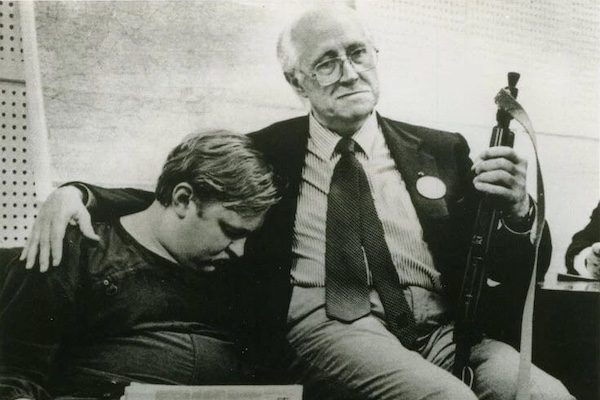
I have returned to this one photograph for years. I first saw it in the 1990s, as a boy, in an American current affairs magazine. An old man holding a rifle. A younger guard resting beside him. The tension in the image was obvious even before I understood its history. The caption, as I remember it, said something close to: awaiting word on whether the military would assault the building.
About a decade ago, I rediscovered the image and learned that the old man was Mstislav Rostropovich, the world-renowned cellist and conductor, whom I remember once seeing perform in Stockholm many years ago. The photograph returned to me again recently, and then, by sheer luck, I found myself in a Paris bookshop and saw a used hardback copy of Elizabeth Wilson’s biography of Rostropovich (ISBN: 9781566637763). I bought it immediately for fourteen euros, a bargain at three times the price, and read it from start to finish over the following weekend.
Since then, I have returned to Wilson’s book several times, listened to Rostropovich’s recordings and interviews, read Claude Samuel’s conversations with him and Galina Vishnevskaya, and wandered further into Shostakovich as a consequence. Wilson’s biography stands out as a terrific and serious piece of work.
Rostropovich’s music, life, and spirit have been unusually sustaining to me at a time when my own spirit has needed some lifting. This text grew out of that encounter: a photograph remembered from childhood, a book found by accident, and the slow recognition that the man in the image was not merely holding a rifle, but carrying the accumulated authority of an entire life.
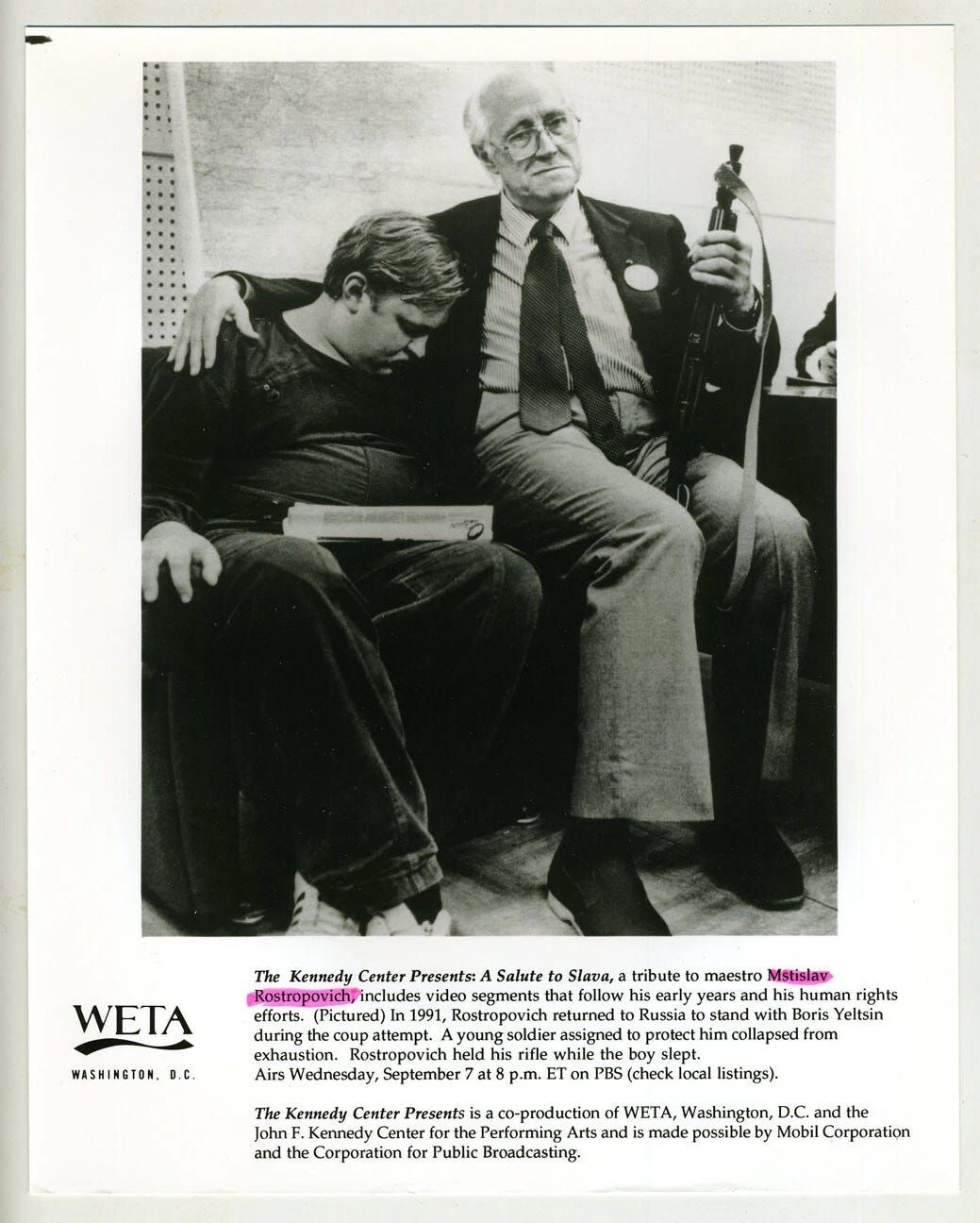
There is a photograph of Mstislav Rostropovich from August 1991 which seems, at first glance, almost too theatrical to be real. The great Soviet-Russian cellist and conductor sits beside a young armed guard during the coup attempt in Moscow. The guard, exhausted, rests against him. Rostropovich, already one of the most famous musicians in the world, holds the young man’s rifle.
The image does not require much explanation. It contains its own argument. Culture and force, age and youth, fatigue and danger are all present in the same small room. Rostropovich is not posing as a soldier. He is not trying to become one; he is simply present, almost tenderly so, at the point where symbols and power briefly meet.
Mstislav Leopoldovich Rostropovich was born in Baku on 27 March 1927, in what was then the Azerbaijani Soviet Socialist Republic. To family, friends, students, and colleagues, he was often simply Slava, the familiar Russian diminutive of Mstislav. He would become one of the defining cellists of the twentieth century, as well as a conductor, teacher, and political actor: a prestige artist who was eventually made an exile, yet never permitted prestige to become a cage. His career cannot be contained by the word “cellist”, even though the cello remained the centre from which everything else radiated. The classroom, the podium, the opera house, and eventually the barricade were not separate theatres. They were extensions of the same life.
The Soviet Instrument
Rostropovich was born into music. His father, Leopold Rostropovich, was a noted cellist and teacher; his mother, Sofiya Fedotova-Rostropovich, was a pianist. In an autobiographical account from 1948, reproduced by Elizabeth Wilson, Rostropovich traced his early life from Baku to Moscow, his father beginning his cello instruction in 1935, his composition studies from 1937, the wartime evacuation, his father’s death in 1942, and his return to Moscow in 1943 to enter the Conservatoire. There he studied cello with Semyon Kozolupov and composition with Vissarion Shebalin; Dmitri Shostakovich was also among his teachers.
It was a severe world, but not a small one: family discipline, wartime displacement, conservatoire training, and the strange Soviet belief that artistic greatness could serve the state without ever exceeding it.
By the mid-1940s, young Rostropovich had already emerged as a Soviet musical phenomenon. He gave his first cello concert in 1942, won the gold medal in the Soviet Union’s first competition for young musicians in 1945, and then took first prizes in Prague and Budapest. In 1950, at only twenty-three, he received the Stalin Prize, then among the highest distinctions available in the Soviet system. He graduated from the Moscow Conservatoire in 1948 and later became professor of cello there in 1956.
This matters, because Rostropovich was not an outsider who rejected a system from the margins. He was formed by Soviet high culture, recognised by it, rewarded by it, and eventually sent abroad as one of its cultural exports. The Soviet Union understood that pianists, violinists, cellists, dancers, conductors, and directors could serve as instruments of prestige: proof that Soviet power did not merely command steel, tanks, factories, and ideology, but could also produce civilisation. Rostropovich belonged to that display, one of the artists through whom the Soviet state wished to show the West that it could produce genius.
The Soviet system produced him; it also tried to discipline him.
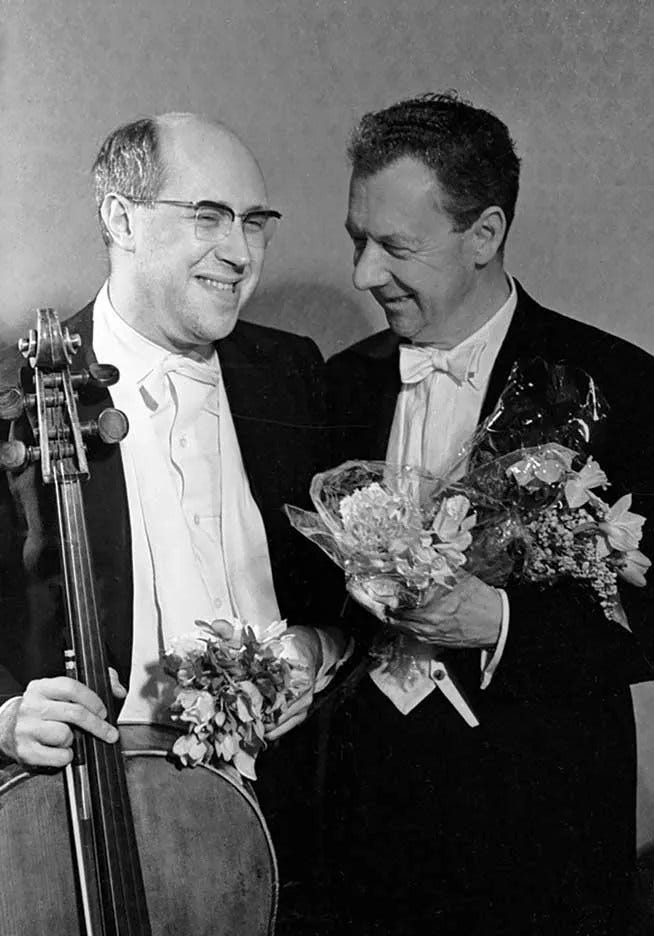
Rostropovich’s importance to the cello is difficult to overstate. Wilson writes that the history of the cello in the twentieth century would be “unthinkable” without him, and describes him as almost a “personification of the cello itself”. That is large language, but in this case it is not empty. Rostropovich was not merely a virtuoso interpreter of an inherited repertoire. He expanded the instrument’s modern literature with unusual force. He inspired and premiered more than one hundred works, forming close artistic relationships with Shostakovich, Sergei Prokofiev, Nikolai Myaskovsky, Henri Dutilleux, Witold Lutosławski, Olivier Messiaen, Luciano Berio, Krzysztof Penderecki, Alfred Schnittke, Leonard Bernstein, Aram Khachaturian, and Benjamin Britten, among many others.
The list of works alone would justify a life. Myaskovsky dedicated his Cello Sonata No. 2 to him, and the two premiered it together in 1949. Prokofiev, inspired by Rostropovich’s playing, wrote his own Cello Sonata, Op. 119, which Rostropovich premiered in 1950 with Sviatoslav Richter. Prokofiev also dedicated his Symphony-Concerto to him. Shostakovich wrote both his first and second cello concertos for Rostropovich, who gave their first performances. Britten dedicated his Cello Sonata, three solo suites, and his Cello Symphony to him.
This was not passive patronage. Rostropovich was not sitting politely, waiting for the twentieth century to provide him with a repertoire. He pursued composers. He pressed them. He understood that an instrument rises in stature when serious composers are forced to treat it seriously. When Lutosławski began work on a cello concerto, Rostropovich reportedly told him, “Don’t think of the cello, I am the cello.” The line is theatrical, of course, but it is also precise. Composers were not merely writing for an instrument. They were writing for a force.
In this sense, his achievement was institutional as much as artistic. He changed not only how the cello was played, but what the cello was allowed to become.
He was also, in Moscow, almost as famous as a teacher as he was as a performer. Wilson, herself one of his students, places Class 19 at the centre of his Soviet musical life: when he was not on tour, Rostropovich taught there on Tuesdays and Thursdays, and over twenty-eight years nearly a hundred young cellists passed through his hands. His teaching was not a narrow transfer of technique. It was a creative laboratory, an extension of the concert hall, where new music, interpretation, discipline, memory, and imagination were pressed into the same service. Wilson also notes that his students called him “Chef”, a private acknowledgement that his classroom authority was as theatrical as it was exacting. The pupils who passed through that room did not merely learn cello. They absorbed a standard of seriousness.
The Conductor Emerges
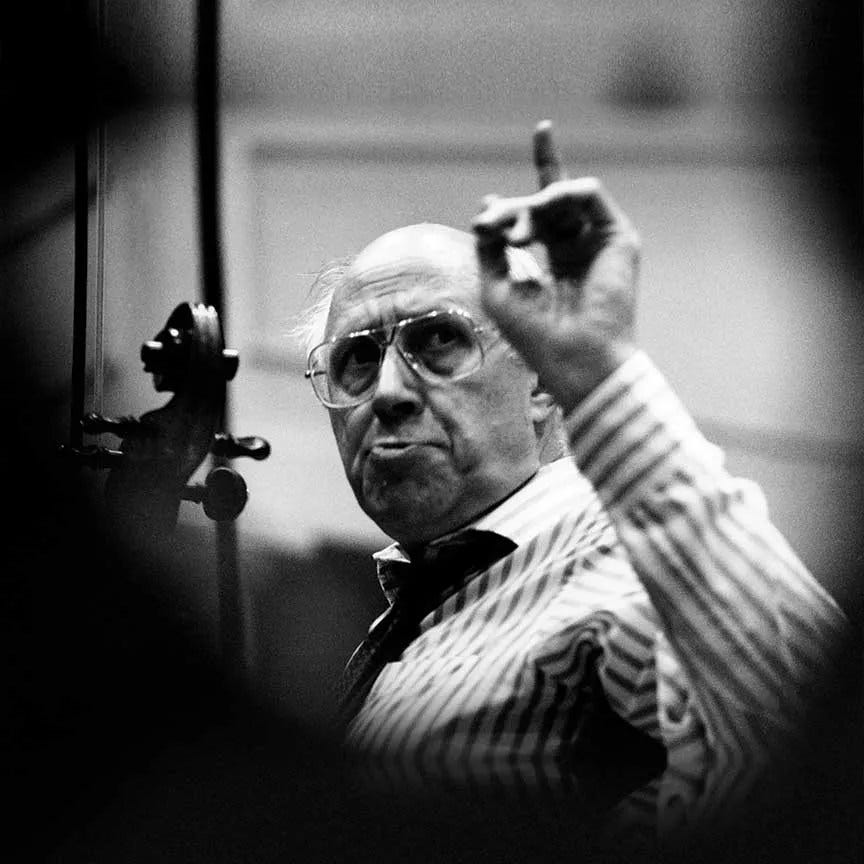
The other part of Rostropovich’s musical life deserves more attention than it often receives. He was not a cellist who merely conducted as a late-career ornament. Khentova’s Rostropovich-Conductor suggests something deeper: before the cello fully took hold, he had already learned to hear music through opera, ensemble, gesture, and score. His father played opera scores from memory to him, singing vocal lines; the boy responded with movement, marking tempo and character with his hands. Even in four-hand piano pieces, Khentova writes, Slava tended to lead, indicating tempo with conductor-like gestures.
That childhood detail matters because Rostropovich’s musical mind was never small. The cello became his principal instrument, but his imagination was not confined to the narrow technical world of the soloist. His composition studies trained him through scores rather than only rules; his early orchestral experiences taught him balance, solo and tutti relations, orchestral polyphony, and the meaning of a conductor’s reading. He understood line, voice, structure, theatre, and the inner machinery of large musical forms. The conductor in him did not replace the cellist. It explained him.
The podium was not a departure from the cello; it was its political analogue.
His later career made this clear. From 1977 to 1994, Rostropovich served as music director and conductor of the National Symphony Orchestra in Washington, D.C., while continuing to perform with major musicians such as Martha Argerich, Sviatoslav Richter, and Vladimir Horowitz. He was not merely a visiting celebrity placed before an orchestra for symbolic value. He became an institutional figure in American musical life, a conductor with a repertoire, a public role, and a platform from which he could shape musical culture beyond his own instrument. Exile did not diminish his importance as a product of Soviet high culture. It sharpened the contradiction. The state that had sent artists like him into the world as proof of Soviet civilisation had driven one of its finest examples into Western exile.
His conducting career also extended into opera and contemporary music. In 1994, he conducted the premiere of Rodion Shchedrin’s opera Lolita at the Royal Swedish Opera, a detail worth preserving because it reminds us that Rostropovich did not retire into safe monumentality. He continued to commission, conduct, provoke, and move across forms. He was a performer, but also a builder of musical circumstances. He created occasions in which music could happen.
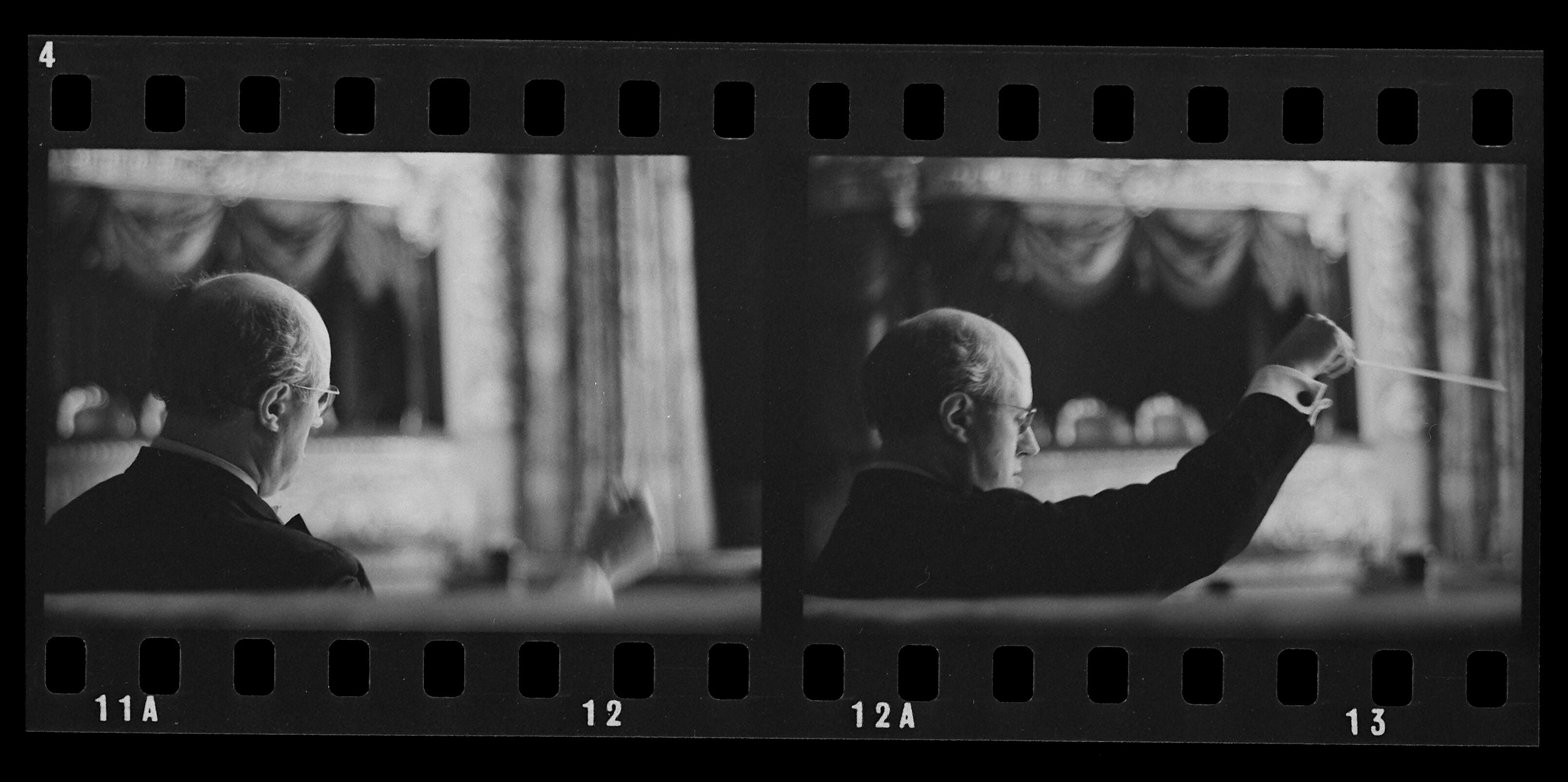
There is a political resonance here as well. Conducting is not only interpretation. It is the disciplined shaping of collective force: command, timing, restraint, release, and trust. It asks one person to draw many voices into an order without killing their distinctness. It is not difficult to see why Rostropovich’s public life carried the same quality. He understood when to stand forward, when to support, when to insist, and when mere presence could become an act.
Loyalty Under Pressure
The conflict with Soviet power did not begin as a formal dissident posture. It began as loyalty: to teachers, to composers, to friends, and eventually to the principle that culture could not remain obedient when conscience had already moved elsewhere.
His relationship with Shostakovich became one of the defining intellectual and artistic loyalties of his life. In 1948, while Rostropovich was still a student at the Moscow Conservatoire, Shostakovich was dismissed from his posts in Leningrad and Moscow after the Soviet campaign against so-called “formalist” composers. Rostropovich quit the conservatoire in protest. The loyalty endured. Years later, after Soviet authorities moved against Shostakovich’s Symphony No. 13, Babi Yar, Rostropovich smuggled the manuscript to the West; its first movement dealt with the Babi Yar massacre.
That episode reveals the steel beneath the exuberance. Rostropovich could be warm, theatrical, and playful, but he was not soft. He understood loyalty as an action, not a sentiment. In the Soviet Union, where careers could be destroyed by silence in the wrong place, or a signature withheld at the wrong time, loyalty to a disgraced composer was not a private matter. It was a public risk.
The same pattern became more dangerous in 1970, when Rostropovich and Galina Vishnevskaya sheltered Aleksandr Solzhenitsyn in their home. Solzhenitsyn had become an enemy of the Soviet authorities and, in Wilson’s account, Rostropovich could no longer remain silent after the campaign against him. He wrote directly to the editors of Pravda, Izvestiya, Literaturnaya Gazeta, and Sovetskaya Kultura, opening by acknowledging that Solzhenitsyn spent much of his time at Rostropovich’s home near Moscow. Vishnevskaya, understanding the likely consequences, helped him correct the letter once she realised he could not be dissuaded. On the way to the airport for a foreign tour, he posted four copies.
The Soviet state understood the offence. Rostropovich had not merely helped a writer. He had broken the bargain expected of prestige artists in authoritarian systems. Such artists may be brilliant, even eccentric, provided that their brilliance remains serviceable. They may be sent abroad, applauded, decorated, and quoted as evidence of national achievement. But they must not decide, independently, where culture ends and conscience begins.
Rostropovich made that decision himself.
The punishment was not immediate theatrical destruction, but something colder. Wilson writes that after 1970 Rostropovich was gradually deprived of the conditions necessary for artistic expression: concert activity was restricted, foreign travel was blocked, and the Moscow Conservatoire became all the more important as a remaining haven. He retained his position there until his enforced departure in May 1974.
That departure, too, deserves a scene rather than a date. In May 1974, just before leaving, Rostropovich gave a final Moscow Conservatoire concert that Khentova describes as an authentic tragic departure. He conducted Tchaikovsky’s Sixth Symphony while security men watched the entrance hall and scrutinised those who came to hear him. Soon afterwards, he and Vishnevskaya left the Soviet Union on what was formally presented as a two-year artistic mission rather than emigration. After a short stay in England, he went to Paris, where Vishnevskaya and their daughters joined him; later, his career would root itself in the United States. In 1978, the Soviet state penalised them by revoking their citizenship on the grounds of actions deemed incompatible with remaining Soviet citizens.
During those years, exile did not reduce him to a nostalgic anti-Soviet symbol. It gave him a second public career: conductor, organiser, advocate, public exile, and one of the great performing musicians of his age.
Exile, Podium, Return
The late 1980s placed Rostropovich back inside history. His impromptu performance during the fall of the Berlin Wall was reported around the world. It was one of those gestures whose power depends on its lack of bureaucratic preparation. A Russian exile, deprived of citizenship by the Soviet state, playing Bach at the symbolic wound of divided Europe: not a speech, not a manifesto, not an institutional communiqué, but a civilisational act of presence.
The restoration of his Soviet citizenship in 1990 carried its own awkward dignity. Khentova records that Rostropovich and Vishnevskaya were discreetly encouraged to apply for restoration of their citizenship, but answered, in effect, that they had not been the ones who refused it. At the insistence of Nikolai Gubenko, then Soviet Minister of Culture, the state restored their citizenship. The gesture mattered because it reversed, however imperfectly, the official fiction of 1978: that the disgrace belonged to the artists rather than to the state that had rejected them.
His return to Russia in 1990 was not a quiet administrative correction. In Claude Samuel’s preface to Russia, Music, and Liberty, Sheremetyevo Airport is crowded with people, cameras, waiting rooms, old friends, public emotion, and the strange reality of a return that had once seemed impossible. Rostropovich and Vishnevskaya then went to Novodevichy Cemetery to pay respects at the graves of Prokofiev, Shostakovich, and David Oistrakh. The route mattered. Before the politics could be narrated, the dead had to be acknowledged.
Then came August 1991.
Samuel records Rostropovich’s own account of the August moment: when he learned of the revolt in Moscow, the music of Prokofiev, Shostakovich, Mussorgsky, and Stravinsky ran through his head. That detail matters. His return was not a departure from music into politics. It was politics entering the same interior chamber where Russian music had always lived.
When news footage showed tanks in the streets of Moscow, Rostropovich was in France. He bought a ticket to Japan on a flight that stopped in Moscow, talked his way out of the airport, and went to join Boris Yeltsin, then President of the Russian Soviet Federative Socialist Republic and the leading elected Russian figure resisting the hard-line coup. The stated hope was not that Rostropovich could command armed men, but that his fame might make a difference to the chance of tanks moving in.
He went to the White House in Moscow, the Белый дом (Bely dom), seat of the Russian republic’s parliament and government and now the centre of resistance to the coup. The building was under threat. Yeltsin addressed the crowds and defenders gathered outside, most famously from atop a tank from the Taman Division. Rostropovich also addressed those assembled in support of the resistance. The photograph of him holding the rifle of an exhausted guard belongs to this moment: an old cellist-conductor inside a collapsing Soviet order, lending his body, name, and symbolic weight to those resisting the return of coercive rule.
The resistance around the White House was not composed only of famous men and formal politicians. It was improvised civic defence. Journalists whose publications had been suspended produced emergency issues on photocopiers and duplicators. Citizens arrived with medicine, sandwiches, and thermoses. Soldiers spoke with civilians and seemed uncertain why they had been mobilised at all. The certainty of command that belongs to a secure state was absent. Contemporary recollections suggest that some tank crews were willing to talk and were not prepared to obey an order to fire on civilians. The coup was therefore not only opposed from above; it was being tested, slowed, and morally contested at street level.
One must be careful not to grant the scene false power through sentimentality. Culture does not stop tanks. Bach does not repeal violence. A cello does not make a regime collapse. But culture can legitimise, focus, and rally. State power falters when its instruments fail, when orders go unheeded, and when the cost of action becomes too high. Symbols matter inside those calculations. A man like Rostropovich, visible inside the White House, did not control the armed balance, but he helped raise the legitimacy of the resistance.
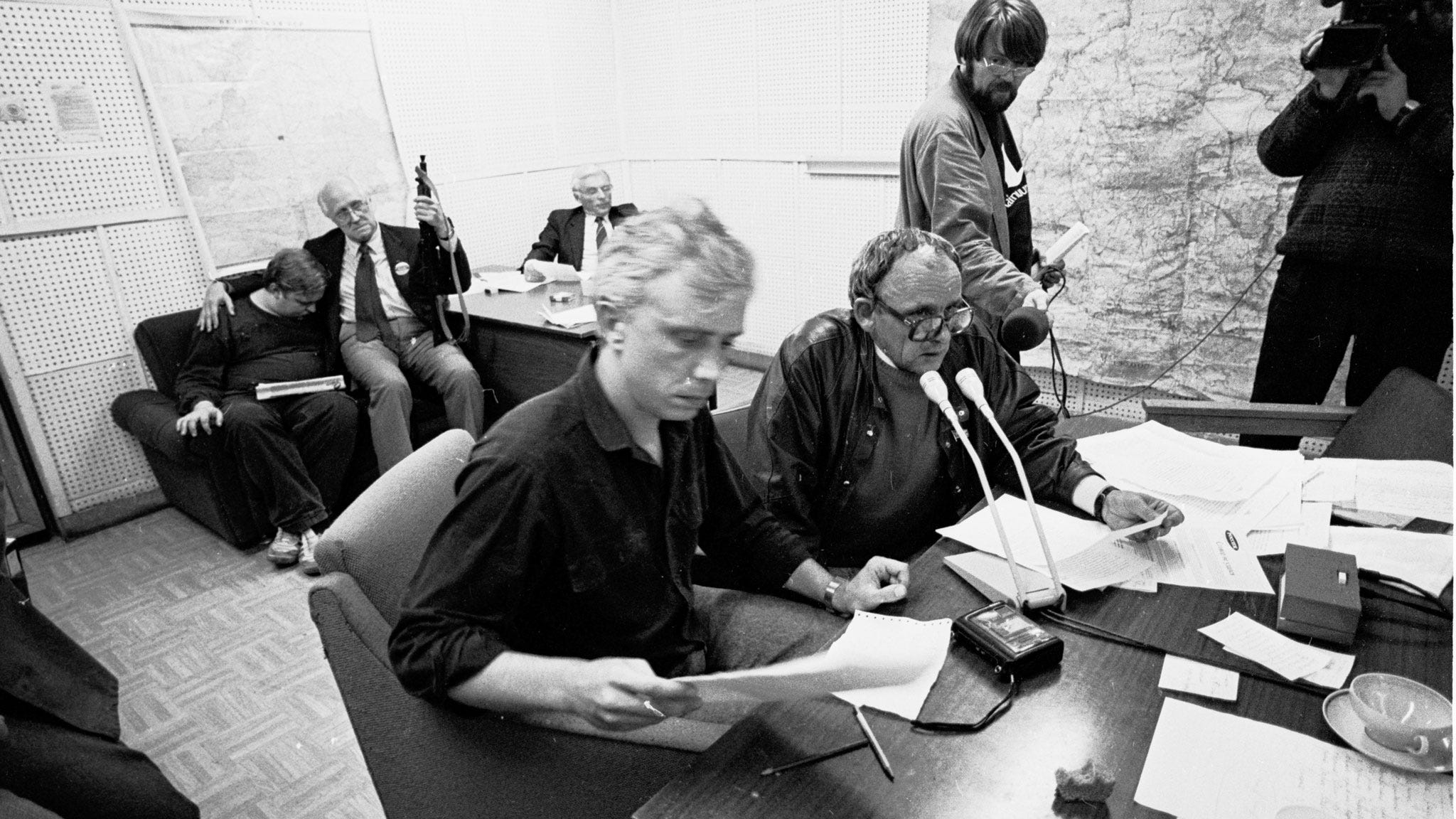
That is why the photograph matters. The rifle is not the essence of the image. The exhausted guard is. According to Olga Rostropovich, the young man beside him was Yura, the guard assigned to protect him. When Yura fell asleep and dropped his weapon, Rostropovich picked it up so as not to wake him. The gesture is small, almost domestic, yet the historical setting makes it enormous. The old artist was not replacing the young defender; he was guarding the guard.
The image would mean less if Rostropovich had merely wandered into history at the end of his life. He had not. It was the culmination of a lifelong sequence: loyalty to Shostakovich, shelter given to Solzhenitsyn, exile accepted rather than obedience, the Berlin Wall, and finally Moscow. When a collapsing empire attempted to reverse its own death, Rostropovich went to the point of decision.
After the Barricades
What followed was quieter, but not separate from what came before.
There is a temptation, especially in liberal cultural writing, to reduce such a life to “the power of art”. That phrase is too easy. Rostropovich’s life shows something harder. Art has no automatic power. Culture becomes power only when embodied by people willing to pay for it. A repertoire does not defend freedom. A famous artist does not become courageous by being famous. The decisive matter is whether a cultivated person, once placed under pressure, remains merely cultivated or accepts responsibility.
After 1991, that same instinct did not disappear; it softened into institution-building. With Vishnevskaya, he founded the Rostropovich-Vishnevskaya Foundation in Washington, D.C., in 1991 to improve the health and future of children in the former Soviet Union. He supported educational and cultural projects as a UNESCO ambassador. He remained connected to Azerbaijan, where the Rostropovich Home Museum opened in Baku in 2002, and he gave master classes at the Azerbaijan State Conservatory.
The world responded with an almost absurd abundance of honours: the Presidential Medal of Freedom, the Kennedy Center Honors, the Polar Music Prize, the Praemium Imperiale, the French Legion of Honour, an honorary KBE, the Royal Philharmonic Society Gold Medal, and many others. Awards can recognise a life, but they can also smooth it over. In Rostropovich’s case, the decorations mattered less than the life lived, a life which repeatedly refused to treat culture as mere decoration.
In 1993, President Yeltsin awarded Rostropovich Russia’s Medal Defender of a Free Russia for courage and dedication during the defence of democracy and constitutional order from 19 to 21 August 1991.
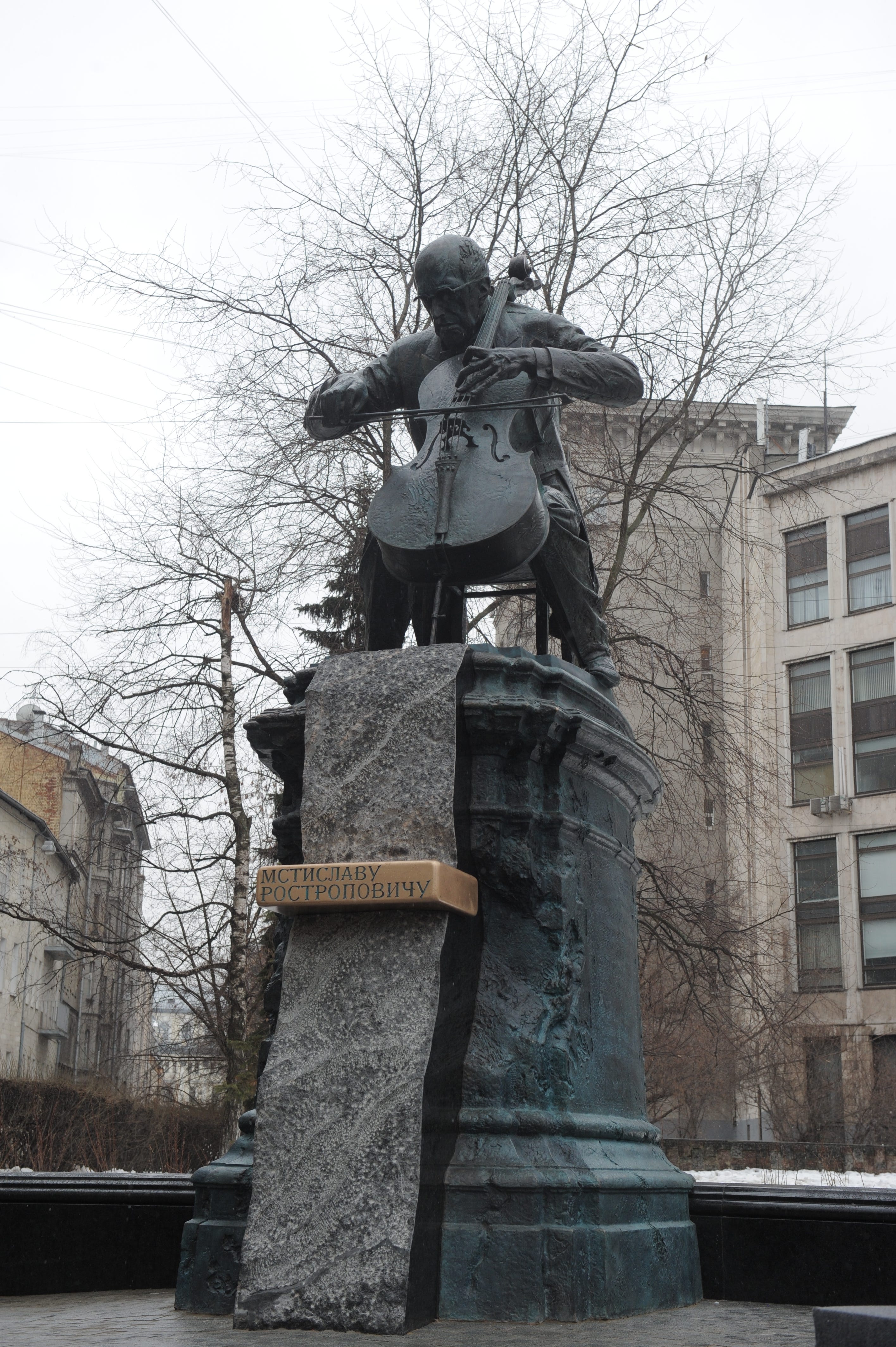
Rostropovich died in Moscow on 27 April 2007, aged eighty. He had been treated for intestinal cancer at the Blokhin Russian Cancer Research Centre. His body lay in an open casket at the Moscow Conservatoire before being moved to the Cathedral of Christ the Saviour, where thousands came to bid farewell. Among the mourners were President Vladimir Putin, Queen Sofía of Spain, Bernadette Chirac, Ilham Aliyev, and Naina Yeltsina. He was buried in Novodevichy Cemetery, close to Boris Yeltsin, who had died only days earlier: a final proximity between the artist who had gone to the barricades and the politician whose resistance he had helped legitimise.
What Remains
There is danger hidden in medals, memorials, plaques, and praise. Those who receive such honours often find that they smooth away their sharpness, making them addicts for more and, eventually, pawns of the state. They are rendered harmless. Rostropovich was never harmless.
He was useful to the state until he refused usefulness on its terms: a prestige asset who became an embarrassment, an exile who became a witness, and a musician whose presence in moments of political rupture carried more weight than many official statements. The conductor matters here. A lesser profile can leave him at the level of virtuoso, but that misses part of his structure. He stood before orchestras, shaped collective force, directed energy, and made many voices move as one.
A man who can receive honours without becoming owned by them, and make many voices move as one, is a dangerous man.
The iconic photograph from August 1991, which inspired this text, endures because it does not truly flatter anyone. It captures a moment in history that may never come again. The young guard is exhausted. The old artist looks tired and worried. The rifle is present, awkwardly held in the hands of a man whose life had been spent producing the signs of a civilisation that tries to discipline man’s basest instincts: violence, war, coercion, and the collapse of speech into force. Rostropovich knew he would not defeat tyranny with a cello. He understood, however, that he could use the authority earned through art, interpretation, discipline, loyalty, and command to raise the political cost of brutality, repeatedly, in places where silence would have been safer. Not because the cellist held a rifle, but because, by then, everyone knew why he was there.
John Sjoholm, for LIMA CHARLIE WORLD
[Subscribe to our newsletter for free and be the first to get Lima Charlie World updates delivered right to your inbox.]
John Sjoholm is Lima Charlie’s Middle East Bureau Chief, Managing Editor, and founder of the consulting firm Erudite Group. A seasoned expert on the Middle East, North Africa, Europe and the Balkans, he has a background in security contracting and has served as a geopolitical advisor to regional leaders. He was educated in religion and languages in Sana’a, Yemen, and Cairo, Egypt, and has lived in the region since 2005, contributing to numerous Western-supported stabilisation projects. He currently resides in Jordan.
Lima Charlie World provides global news, featuring insight & analysis by military veterans, intelligence professionals and foreign policy experts Worldwide.
For up-to-date news, please follow us on twitter at @LimaCharlieNews

Selected References
Elizabeth Wilson, Rostropovich: The Musical Life of the Great Cellist, Teacher, and Legend. Chicago: Ivan R. Dee, 2008.
Mstislav Rostropovich and Galina Vishnevskaya, Russia, Music, and Liberty: Conversations with Claude Samuel. Translated by E. Thomas Glasow. Portland, Oregon: Amadeus Press, 1995.
S. Khentova, Rostropovich-Conductor. Translated by Marina V. Litvinova. St Petersburg: Gosco, 1993.
Nadezhda Azhgikhina, “August 1991: ‘Today they attacked the press; tomorrow everyone will find themselves in conditions of unfreedom’”, Yury Shchekochikhin Foundation.
In case you missed it:

![Image Russia and China’s 'hybrid warfare' - Does the West even care? [Lima Charlie News]](https://limacharlienews.com/wp-content/uploads/2019/04/Russia-China-Hybrid-Warfare-02-480x384.png)