

The most durable power is not enforced at gunpoint; it is embedded in systems.
My industry has a simple rule: never do something for one reason when you can do it for fifty. Mature statecraft is built on that logic. Instruments are never singular. Financing shapes procurement; training rewires doctrine; standards lock in industrial orientation; cultural exchange engineers elite formation. When policy reorganises incentives, dependencies, and decision space simultaneously, power stops being an action and becomes an architecture.
The most effective power is not perceived as power, but lived as environment.
Europe operates in a strategic interregnum. As such, nothing can truly be done in an expedient fashion. Military capability can be rebuilt, but not quickly; procurement remains largely national, command structures uneven, and strategic cultures divergent. Some governments prioritise deterrence, others fiscal restraint, others domestic stability. The Union’s institutional architecture embeds veto points that external actors exploit with minimal effort, allowing pressure applied in one capital to stall policy across the Union. Under such conditions, hard power becomes slow, politically costly, and unevenly deployable, while structural influence accumulates quietly and functions below the threshold of obstruction.
Soft power remains one of the most efficient instruments available because it alters preference rather than behaviour. Military force compels action; structural influence shapes the field in which choices are made. Coercion produces compliance; embedded systems produce alignment. Once alignment is built into procurement chains, regulatory frameworks, training pipelines, and financial instruments, influence ceases to appear as such and becomes environment. Actors no longer comply with pressure; they operate within systems whose logic they have internalised.
Soft power is often misunderstood as the ability to be liked. It is not. It is the ability to define reality in such a way that others organise themselves within your preferred order. Attraction may open the door; structure determines where the corridors lead thereafter.
Theodore Roosevelt observed, “Speak softly and carry a big stick; you will go far.” In a networked age, the “big stick” is no longer primarily military force. It is standards, financing, logistics, digital architecture, industrial integration, and the leverage embedded in systems others cannot function without.
This begins with vocabulary. When legitimacy, development, governance, and security are defined using your conceptual language, others are already operating inside your system. Policymakers draft legislation using your frameworks; universities adopt your accreditation standards; media debates unfold within your normative frames; businesses orient toward regulatory compatibility. None of this requires coercion. It requires interpretive gravity.
Interpretive control precedes alignment. Alignment precedes dependency.
The strategic environment that once made European dependency appear permanent has shifted. The United States remains the central military actor in Europe, yet its strategic bandwidth is finite and its prioritisation increasingly oriented toward the Indo-Pacific. Domestic political fragmentation constrains strategic continuity, and capability without political durability weakens enforcement credibility. American cultural primacy no longer operates with universal reach; digital fragmentation has dissolved narrative monopolies; legitimacy contests unfold in decentralised information ecosystems. The United States retains immense influence, yet its gravitational field has weakened. Hard power unsupported by cohesion and legitimacy becomes progressively more expensive to sustain and less persuasive in effect.
Structural influence, applied deliberately, produces not allies but dependencies. The vocabulary of partnership obscures the operational reality. When a state adopts your technical standards, integrates your defence systems, trains its officers in your doctrine, finances its infrastructure through your institutions, and educates its administrative elite within your frameworks, its strategic options narrow. Procurement cycles orient toward your industry, regulatory environments align with your norms, and professional classes internalise your assumptions. Defection becomes materially irrational; sovereignty remains intact, while autonomy contracts.
Reliance emerges gradually: export economies orient toward the dominant market; infrastructure networks bind peripheries to central hubs; security cooperation produces interoperability; elites are trained within the dominant system; cultural aspiration aligns with its centre. At that point, realignment becomes prohibitively costly. The state remains sovereign; its choices are controlled.
Ukraine illustrates these mechanics with unusual clarity. European support is publicly framed as solidarity and defence of sovereignty; structurally, it constitutes an integration process. Sweden’s engagement demonstrates how assistance can function simultaneously as defence support and systems integration. Interoperability requirements, sustainment dependencies, training pipelines, sensor integration, and munitions compatibility bind Ukrainian defence capacity to European supply chains for decades. Funding directed toward domestic Ukrainian production capacity does not eliminate dependency; it relocates it within a European technical ecosystem. Officers trained within European interoperability frameworks will spend entire careers operating inside those systems, and industrial integration becomes strategic orientation.
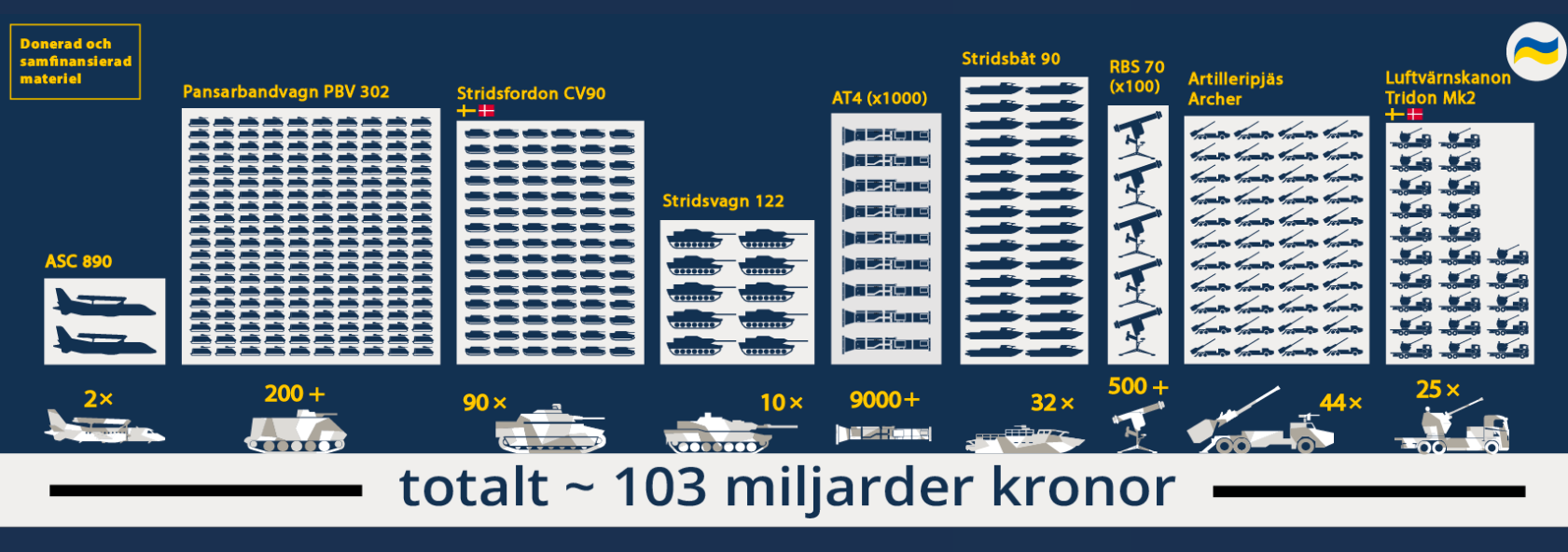
The scale of Swedish assistance illustrates the depth of this integration. On the 19th of February 2026, Stockholm announced its 21st military aid package to Ukraine, one of the largest to date. To date, Sweden has committed approximately 103 billion SEK (≈ €9–10 billion) in military support since the full-scale invasion began. This latest package alone, valued at 12.9 billion SEK (≈ €1.1–1.2 billion), includes a modular mobile air-defence concept designed to counter mass drone and missile attacks, substantial ammunition deliveries, training and sustainment for previously supplied systems, and a cooperative programme with Ukrainian industry focused on long-range drones and innovation.
Portions of the funding support Ukraine’s own defence production capacity, ensuring that future output remains interoperable with European systems and embedded within European supply chains, maintenance cycles, and software ecosystems. Publicly framed as urgent support for Ukrainian defence, it structurally anchors Ukraine’s future defence capacity within a European technical architecture.
Through soft power one gains a de facto, albeit undeclared, client state; with it come industrial capability, long-term procurement streams, maintenance contracts, regulatory harmonisation, and supply-chain lock-in. More importantly, dependence is embedded. The actor that maintains the software, replaces the components, certifies the standards, and trains the personnel does not need to issue commands; alignment becomes the default operating condition.
“Never do something for one reason when you can do it for fifty.“
Joseph Nye defined soft power as the ability to shape outcomes through attraction and persuasion. That definition remains useful in cultural and diplomatic contexts. Yet when influence operates through supply chains, regulatory ecosystems, financing structures, and technological integration, attraction alone is insufficient. In a harder age, soft power acquires structural leverage, incorporating geo-economic alignment and institutional lock-in. What emerges is attraction reinforced by dependency and preference reinforced by systemic necessity. The term evolves from persuasion into architecture: a modern instrument for extending reach and constructing durable alignment without territorial control.
Industrial dependence outlasts ideological alignment. Governments change; supply chains persist. Influence embedded in systems survives electoral cycles. Durable influence rests on sequence and design: exporting standards before systems, embedding training pipelines that reproduce doctrine, integrating digital architectures that produce lock-in, structuring financing around interoperability, and educating elite cohorts within your institutional frameworks. Soft power is not messaging. It is system design.
Strategic competition increasingly concerns definitions. Russia frames liberalism as decadence and sovereignty as civilisational defence. China frames development as stability and non-interference. The United States frames openness as order and opportunity. Europe often responds with procedure.
If Europe does not define order, legitimacy, and stability, others will. One should never fear the knife’s edge when one is wielding the blade.
This blueprint is already contested elsewhere. Africa represents the next decisive theatre of structural influence, where infrastructure, energy systems, digital networks, and urban growth corridors will determine alignment for generations. The mechanisms are already visible. Digital infrastructure now forms the nervous system of governance and commerce: subsea cables, national fibre backbones, data centres, and government cloud services embed standards, cybersecurity protocols, and vendor ecosystems that shape regulatory alignment and intelligence relationships for decades. When public administration, financial systems, and telecommunications networks operate on external architectures, interoperability becomes orientation; the technical layer quietly fixes the political horizon.
Port concessions and logistics corridors extend this architecture into physical trade flows. Terminal management systems, customs platforms, and inland transport links reorganise commercial gravity around the ecosystems that finance, insure, digitise, and secure them. Once export economies depend on a particular logistics architecture, realignment becomes economically disruptive rather than politically difficult.
Control of strategic minerals adds a further dimension. Rare earth elements, cobalt, lithium, and manganese are not merely commodities; they are inputs to energy transition systems, advanced manufacturing, and defence supply chains. Securing extraction rights, processing capacity, and transport corridors is not only a matter of supply. It is a means of shaping industrial dependence and, equally, of preventing adversarial control. In strategic competition, victory is measured by the ability to exploit an advantage or deny it to others.
The contest is therefore not only material but interpretive.
Exploitation versus alignment is in the eye of the beholder and is dependent on narrative framing and control.
What the centre experiences as stability and interoperability may be experienced elsewhere as constraint. The structure remains the same; only the discourse changes. China has operated along this logic for two decades; Gulf capital moves with speed and precision; Russia offers security instruments tied to resource concessions and political insulation. Should Europe abstain from structural engagement, others will construct the dependencies that shape future alignment, leaving Europe to purchase access at a premium to systems designed by others.
European external assistance must therefore be reconceived as an operational dual-use instrument. Aid can no longer function as a moral gesture; it must operate as strategic architecture across multiple domains and be grounded in operational realities rather than the idealistic abstractions often produced in insulated bureaucratic environments or electoral political cycles. Its purpose is to extend influence and create long-term economic and strategic advantage. While it might be sold when needed as a moral project, it should never in reality be one.
Over time, such assistance should orient partner states toward full dependency on European systems and practices. Financing should be tied to standards. Infrastructure must be embedded within European regulatory ecosystems. Energy systems should integrate with European supply and technology chains. Education programmes must cultivate administrative and technical elites formed within European frameworks. Credit instruments should incentivise interoperability.
This approach places assistance within strategic planning and aligns it with defence, industrial, and security interests. It therefore requires intelligence-led prioritisation and assessment to determine where engagement produces durable alignment and where resources generate structural leverage rather than symbolic visibility.
States orient toward the centre of provision rather than the centre of rhetoric. Provision determines alignment. European external assistance must therefore be reconceived as strategic architecture. Financing tied to standards, infrastructure integrated into European regulatory ecosystems, energy systems linked to European supply chains, and education programmes that cultivate administrative and technical elites trained within European frameworks together produce durable alignment. This is not domination. It is gravitational pull.
Such an approach requires less the culture of consensus associated with Brussels and Stockholm, and more the disciplined realpolitik once practised in and by Venice, Vienna, and always by Paris; a Janus-faced posture in which outward language emphasises partnership, development, sustainability, and shared prosperity, while inward design secures industrial advantage, strategic alignment, and long-term influence. The two are not contradictory; they operate on different planes. This duality is not duplicity but function: legitimacy sustains consent, while structure secures durability. Public legitimacy requires moral vocabulary; structural durability requires strategic design. Citizens are reassured by narratives of solidarity and responsibility, while systems operate according to incentives, dependencies, and alignment.
This follows a familiar and well-established pattern: compliance is framed as reform, dependence as integration, and alignment as progress.
The most durable dominion is the one its participants do not recognise, where enforcement recedes and alignment becomes a way of life, sustained because alternatives no longer appear compatible with it. This is the hardest form of soft power.
The logic is not new. Theodore Roosevelt observed, “Speak softly and carry a big stick; you will go far.” In a networked age, the “big stick” is no longer primarily military force. It is standards, financing, logistics, digital architecture, industrial integration, and the leverage embedded in systems others cannot function without.
Europe remains uncomfortable with the language of power. Its public vocabulary privileges partnership, values, solidarity, and cooperation. Such language is politically necessary; it is strategically insufficient. Power that refuses to name itself does not cease to operate; it operates without conscious direction. The Union must therefore function in two registers simultaneously: normative language outward, structural design inward. The first reassures; the second secures.
Structural influence, executed with discipline, shapes incentives, embeds dependencies, and narrows strategic alternatives while presenting itself as cooperation. Because it appears benign, it provokes less balancing behaviour than overt coercion; because it is systemic, it endures.
Europe cannot match major powers in hard-power scale in the near term, yet it can out-integrate, out-standardise, and out-regulate them, reorganising neighbouring regions through alignment with systems they cannot function without. Under such conditions, dominion is administered rather than imposed, embedded in interoperability requirements, maintenance cycles, certification regimes, and professional formation pathways, accepted because it appears rational and sustained because alternatives become impractical.
A fragmented Europe becomes terrain. A cohesive Europe becomes an actor.
Soft power is the means by which influence becomes structure and structure becomes order. Without it, Europe’s borders shrink to its frontiers; with it, Europe’s security perimeter extends to its systems.
Influence persuades; dependency decides; irreplaceability ensures compliance.
John Sjoholm, for LIMA CHARLIE WORLD
[Subscribe to our newsletter for free and be the first to get Lima Charlie World updates delivered right to your inbox.]
John Sjoholm is Lima Charlie’s Middle East Bureau Chief, Managing Editor, and founder of the consulting firm Erudite Group. A seasoned expert on the Middle East, North Africa, Europe and the Balkans, he has a background in security contracting and has served as a geopolitical advisor to regional leaders. He was educated in religion and languages in Sana’a, Yemen, and Cairo, Egypt, and has lived in the region since 2005, contributing to numerous Western-supported stabilisation projects. He currently resides in Jordan.
Lima Charlie World provides global news, featuring insight & analysis by military veterans, intelligence professionals and foreign policy experts Worldwide.
For up-to-date news, please follow us on twitter at @LimaCharlieNews
In case you missed it:

![A Trump war crime pardon dishonors us all [Lima Charlie News]](https://limacharlienews.com/wp-content/uploads/2019/05/A-Trump-war-crime-pardon-dishonors-us-all-Lima-Charlie-News-480x384.png)
![Image Imagine a Global Space Community ... The Space Foundation Can [Lima Charlie News][Graphic by Anthony A. LoPresti]](https://limacharlienews.com/wp-content/uploads/2019/03/Space-Foundation-Space-Symposium-Lima-Charlie-News-480x384.png)





![A Trump war crime pardon dishonors us all [Lima Charlie News]](https://limacharlienews.com/wp-content/uploads/2019/05/A-Trump-war-crime-pardon-dishonors-us-all-Lima-Charlie-News-150x100.png)