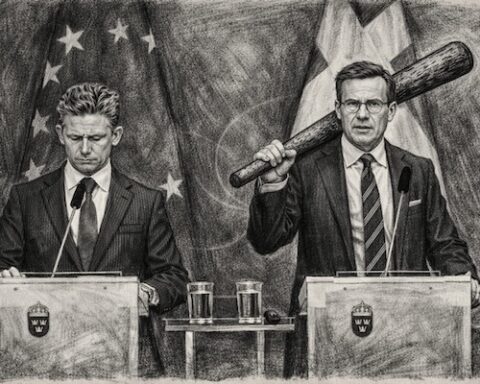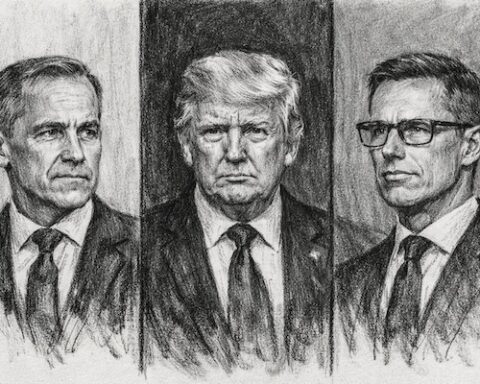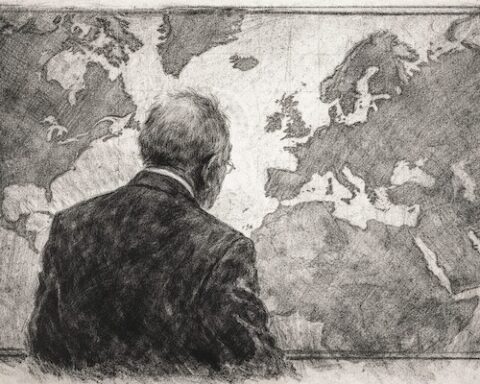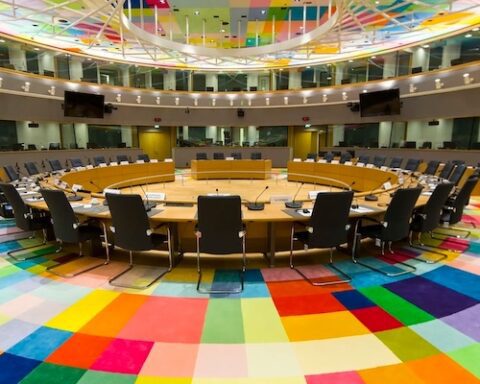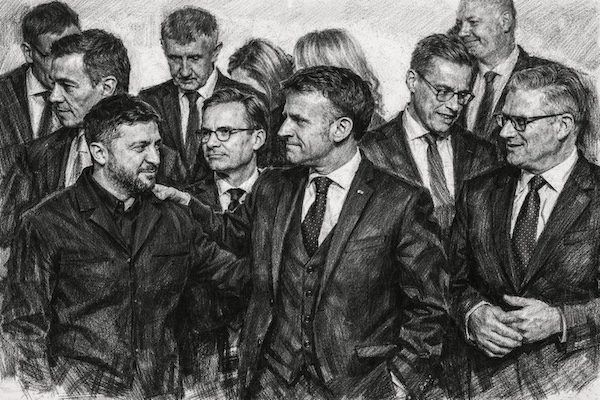
A frozen conflict would be a Russian victory in anything but name.
Why a frozen conflict in Ukraine would amount to a Russian victory—and why Europe’s real vulnerability lies not in military weakness, but in political entropy.
I consider it likely that Russia will, de facto, win its war on Ukraine. Not because Ukraine collapses militarily, but because the West succumbs to political entropy of its own making. The failure will not be measured in kilometres lost on a map. It will be measured in attention span, in parliamentary calendars, in the relief of a ceasefire sold as “stability”. Strategic defeat is often administered as fatigue.
A frozen conflict is not a compromise. It is a Russian victory in instalments. It gives Moscow what it most requires: time, legitimacy, and relief from consequences. It does not require tanks in Kyiv or formal capitulation. It requires only exhaustion. Front lines freeze, sanctions erode, attention drifts, and the lesson is absorbed: borders can be changed by force if the aggressor can endure sanctions longer than democracies can endure discomfort.
This is not the cinematic victory the Western audience prefers. It is the more dangerous kind. One that trains the international system to accept new rules without ever announcing them. Incremental gains, each individually tolerable, cumulatively decisive. A method as old as power itself. Salami tactics work precisely because no single slice appears worth escalation. [1]
There is a reason serious scenario planners keep returning to this outcome. Strategic disasters rarely arrive with fanfare. They creep in through denial and moral language, dressed up as prudence. That is the real danger of the current Western posture: the tendency to treat Ukraine as a problem to be managed, rather than the forward line of Europe’s own survival. In that framing, support becomes charity. Charity is optional. Survival is not. Once Ukraine becomes optional in the European mind, Russia has already won half the war.
What is at stake is not Ukraine alone, but whether Russia’s attempt at manifesting its destiny is allowed to succeed. The phrase is deliberate. Moscow’s project rests on the same logic that once underpinned American expansion: that history confers entitlement, that power converts precedent into right, and that resistance is illegitimate if it delays the inevitable. Allowing this logic to prevail in Europe would not stabilise the continent. It would teach every revisionist actor exactly how much violence is required to redraw the map.
A Russian “win” would not stop with Ukraine. It would radiate. Not because Moscow intends immediate territorial expansion across Europe, but because success would validate a particular interpretation of the European condition: that unity is decorative, commitments theatrical, and declarations substitutes for enforcement. These claims already circulate within Europe’s own sceptical elites. Moscow’s task is not to invent them, but to weaponise their most corrosive version.
We already see where this logic finds political expression. Hungary has built an entire foreign policy around obstruction as leverage [2]. Slovakia has drifted openly toward accommodation [3]. Others will follow if the lesson is learned that European unity carries no cost when violated. Russia does not need allies in Europe. It needs amplifiers and delays.
Failure in Ukraine would also sharpen the risk picture in the Baltic theatre. A frozen front would free Russian capacity for intensified active measures: disinformation, political sabotage, cyber operations, provocation, and engineered “local” incidents designed to confuse thresholds and fracture resolve [4]. Estonia, in particular, sits where geography, demography, and alliance credibility intersect [5]. The objective would not be immediate conquest, but ambiguity: to test whether Europe and NATO act before the situation clarifies itself. That is how Article 5 is hollowed out in practice.
European behaviour already shows that this threat is understood, if rarely articulated honestly. Sweden offers a case in point. After decades of dismantling its Cold War posture, Swedish defence spending has more than doubled since 2020, reaching roughly SEK 120 billion by 2024 and rising further in 2025 [6]. The direction is no longer incremental but structural: rebuilding readiness, reconstituting units, expanding stockpiles, and accelerating procurement across air defence, artillery, naval capacity, and ISR [7]. Conscription has been expanded well beyond symbolic levels [8]. This is not ideological militarism. It is recognition.
The assumption that Russia’s imperial reflex had exhausted itself collapsed in 2008, and definitively in 2014. By 2018 Sweden was distributing civil-defence guidance to every household—something not done since 1961—explicitly preparing the population for crisis, including war [9]. In 2024 the guidance was updated again, with a sharper emphasis on resilience under sustained disruption [10].
The Baltic states went further, earlier, and with fewer illusions. Lithuania’s “how to survive another occupation” manual was never symbolic; it reflected lived memory and specified method [11]. Defence spending across Lithuania, Latvia, and Estonia now consistently exceeds 2 percent of GDP, with Lithuania approaching or exceeding 3 percent [12]. Finland, Norway, and Denmark have likewise accelerated rearmament and force posture adjustments since 2022 [13]. The region is re-arming not because it enjoys the language of war, but because it recognises the language of power.
Sweden, untouched by war since 1814, has aligned its planning with a harsher truth: a Russian move against the Baltics is treated as an existential threat. Doctrine follows accordingly. Maritime priority lies in rapid trans-Baltic movement of troops and heavy equipment under pressure, because the decisive window would be measured in days, not months [14].
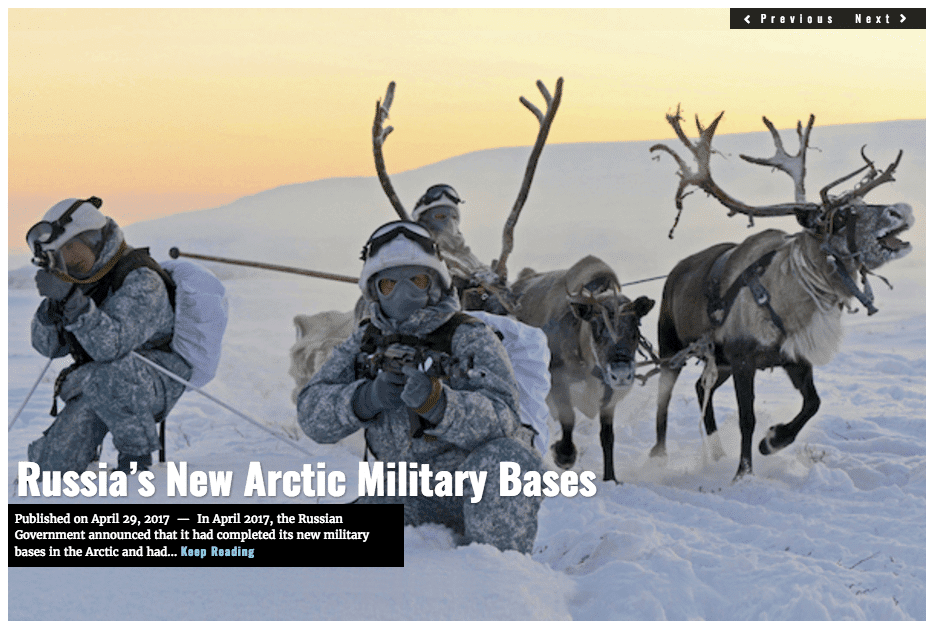
There is, however, a weakness in how this rearmament is justified. Much of Europe’s defence expansion is rhetorically tied to two contingent narratives: American unreliability and immediate Russian aggression in Ukraine. Both are real. Both are insufficient. A frozen conflict, a performative détente, or a shift in U.S. tone would be enough to reopen the argument that the emergency has passed.
Rearmament built on contingency is reversible. Strategy built on structure is not.
What Europe lacks is not threat awareness, but permanence of intent. Defence must be treated as fixed infrastructure rather than emergency expenditure; as a baseline requirement of sovereignty rather than a reaction to crisis.
Europe prefers to speak in norms because norms are inexpensive. Enforcement is not. Rules matter only when their violation carries predictable cost. Capacity produces order. Order produces compliance. Compliance is later narrated as legitimacy. Europe still speaks as if legitimacy itself generates capacity. It does not.
This misreading shapes how erosion is interpreted. Restoration is mistaken for deterrence. Systems are repaired. Services resume. Officials declare success. But sabotage that teaches an adversary how quickly a system can be repaired—and at what cost—has not failed. It has gathered intelligence. Without an imposed price, resilience is maintenance. Maintenance is not strategy.
A frozen conflict would institutionalise this error. It would allow Russia to rearm, reorganise, and refine methods while Europe congratulates itself on having avoided escalation.
Ukraine is therefore not a peripheral theatre. It is the perimeter. Not symbolically, but materially. It is where European security is currently being paid for in Ukrainian lives rather than European ones. Financing Ukrainian resistance is not a gesture of solidarity; it is advance payment on Europe’s own security architecture.
If Russia is decisively defeated, buffers can be consolidated, thresholds re-established, and the central lesson restored: that force carries a cost that outweighs the gain. These are not moral ambitions. They are fiscal and strategic necessities.
This clarifies the question of frozen Russian assets. Europe hesitates because it frames the issue legally rather than strategically. But the Roman logic is unambiguous: quod ab hostibus captum est, statim fit victoris [15]. What is taken in war belongs to the victor. Not because it is moral, but because it is how power functions when no higher authority reverses outcomes. Russia can reclaim frozen assets only if Europe loses and retrospectively normalises Moscow’s actions. If Putin’s project is strategically nullified, the assets remain forfeited. Funding European and Ukrainian security with them is not expropriation. It is consequence.
That is why the relevant question is not whether Europe can “end the war”, but whether it is willing to sustain enforcement long enough to make Russian success structurally impossible. In such a posture, aid is not altruism but forward defence. Sanctions are not moral signalling but instruments of attrition. Seized assets are not symbolic punishment but war finance. Each element only works if it is treated as permanent rather than provisional.
This, in turn, forces a question Europe has spent a decade postponing. Strategic autonomy cannot be improvised through budget uplifts and communiqués. It requires an integrated defence-industrial base capable of producing at scale, procurement rules that treat time as a weapon rather than a constraint, and a command structure able to act without waiting for American domestic politics to stabilise. Above all, it requires deterrence that is credible in the only language great powers consistently respect: the capacity to impose unacceptable cost.
A frozen conflict would institutionalise this error. It would allow Russia to rearm, reorganise, and refine methods while Europe congratulates itself on having avoided escalation.
This leads to the issue Europe still prefers to leave implicit. Continental deterrence ultimately requires a nuclear backstop that is not merely theoretical. Europe can continue to live under borrowed guarantees, hoping American politics remains predictable, or it can begin the long, expensive task of building a European nuclear guarantee that is institutionally anchored and operationally credible.
This is recognition of structure. In a system where power is returning to first principles, the final guarantee cannot be outsourced indefinitely without hollowing out sovereignty itself.
None of this will be popular. None of it will be framed honestly. But neither would a frozen conflict be named for what it is: failure disguised as stability. Europe can pay to enforce its perimeter in Ukraine now, or pay to enforce it later on its own territory. The second bill will be higher, in money and in blood.
Ukraine will continue to fight for its survival regardless. What remains undecided is whether Europe recognises that this war is also its own.
Vae victis. Woe to the conquered. Europe must decide whether that phrase will describe Ukraine, or Russia’s method. The war is ours to lose.
[Referencess below]
John Sjoholm, for LIMA CHARLIE WORLD
[Subscribe to our newsletter for free and be the first to get Lima Charlie World updates delivered right to your inbox.]
John Sjoholm is Lima Charlie’s Middle East Bureau Chief, Managing Editor, and founder of the consulting firm Erudite Group. A seasoned expert on the Middle East, North Africa, Europe and the Balkans, he has a background in security contracting and has served as a geopolitical advisor to regional leaders. He was educated in religion and languages in Sana’a, Yemen, and Cairo, Egypt, and has lived in the region since 2005, contributing to numerous Western-supported stabilisation projects. He currently resides in Jordan.
Lima Charlie World provides global news, featuring insight & analysis by military veterans, intelligence professionals and foreign policy experts Worldwide.
For up-to-date news, please follow us on twitter at @LimaCharlieNews
In case you missed it:
References:
[1] Salami tactics / faits accomplis in great-power expansion — Texas National Security Review (TNSR) — https://tnsr.org/2021/11/salami-tactics-faits-accomplis-and-international-expansion-in-the-shadow-of-major-war/
[2] Overcoming the Hungarian Veto – Verfassungsblog – https://verfassungsblog.de/hungarian-veto-russian-central-bank-assets/
[3] Slovakia’s Fico announces halt of military aid to Ukraine – Politico – https://www.politico.eu/article/slovakia-robert-fico-announce-halt-military-aid-ukraine/
[4] Active Measures: Russia’s Covert Geopolitical Operations – GCM, – https://www.marshallcenter.org/en/publications/security-insights/active-measures-russias-covert-geopolitical-operations-0
[5] Estonia, deterrence, and NATO credibility (Baltic frontline context) — NATO Enhanced Forward Presence (Estonia) — https://www.nato.int/cps/en/natohq/topics_136388.htm
[6] Sweden defence spending 2020–2025 – Government of Sweden – https://www.government.se/government-policy/total-defence/
[7] Swedish Armed Forces capability rebuild – Försvarsmakten – https://www.forsvarsmakten.se/en/activities/defence-reform/
[8] Swedish conscription expansion – FOI – https://foi.se/download/18.36d9c930183e4cb3310ff/1667315254524/FOls-underlag-infor-nasta-forsvarspolitiska-inriktningsbeslut.pdf
[9] If crisis or war comes brochure (2018) – MSB – https://www.mcf.se/en/advice-for-individuals/the-brochure-in-case-of-crisis-or-war/download-and-order-the-brochure-in-case-of-crisis-or-war/
[10] Updated civil defence guidance (2024 version) — MSB (Om krisen eller kriget kommer / updated materials hub) — https://www.msb.se/en/om-myndigheten/publikationer/om-krisen-eller-kriget-kommer/
[11] Lithuania civil resistance manual – Lithuanian MOD – https://kam.lt/en/civil-resilience/
[12] Baltic defence spending data – NATO – https://www.nato.int/cps/en/natohq/topics_49198.htm
[13] Nordic rearmament and spending trends (comparative data) — SIPRI Military Expenditure Database — https://www.sipri.org/databases/milex
[15] Roman law of war (ius belli) – Digest of Justinian, Book 49