Toute vérité n’est pas bonne à dire: Purchased Frontiers.
“War is not about who is right, but who is left.”
Sweden does not suffer from incompetence. We build precise instruments of violence without melodrama. Gripen, Archer, autonomous drones, hardened air-defence, encrypted communications, and surveillance systems that turn geography into visibility. Our officers now rise into NATO’s highest intelligence structures not because we are large, but because we are exact. When Generalmajor/OF-7 Lena Persson Herlitz was appointed Deputy Assistant Secretary General for NATO Intelligence, it was not a political gesture. It was an admission. Sweden produces minds and machines that can keep Europe alive longer than its politicians deserve.
Tools, however, only matter if someone is willing to use them. Swedish Defence Research Agency (FOI)’s recent findings reveal two fractures that cannot be hidden under patriotic language. First, willingness to serve conscript duty correlates not with nationalism, but with class and belonging. The children of high-income, highly educated households are the most willing to defend Sweden. The least willing are those born here to foreign-born parents. They hold Swedish passports but lack a sense of ownership over the Swedish project. A nation that cannot form an “us” cannot command an “ours.”
The second truth is colder: conscription imposes a financial penalty. One year of duty delays income and pension gains enough to cost an average of 553,000 kronor (≈ $50,000 USD) across a lifetime. The state reimburses only a fraction and disguises the rest as honour. Sacrifice becomes noble only because someone else is forced to bear it. A country that wants protection must compensate its protectors. Sweden has not.
This crisis is not uniquely Swedish. Across Europe, the defence challenge is not military. It is demographic and psychological. Europeans are not pacifists. They are consumers of security. They want safety to exist, so long as someone else assumes the risk exposure. Two-thirds of EU citizens do not believe their armies could defend them against a Russian attack. They want protection, but without participation. So the cost of war must be transferred to those willing to fight it.
Europe will not pay Ukrainian pensions. It will pay for Ukrainian ammunition.
A recent Norwegian analysis, offers the bill. If Russia secures even a partial victory, Europe must rearm, harden borders, absorb massive refugee flows, and militarise society. Cost: €1.2–1.6 trillion (≈ $1.3–1.7 trillion USD) over four years. Financing Ukraine to a functional victory costs €522–838 billion (≈ $565–900 billion USD). The logic is not moral. It is arithmetic. It is cheaper to have Ukrainians kill Russian soldiers now than to have Europeans do it later.
Some claim Russia invaded Ukraine to secure a NATO buffer. This fiction masks an imperial mission: erasing Ukrainian identity. The irony is that Europe, not Russia, genuinely requires buffers—not to dominate them, but to avoid being dominated. A heavily armed Ukraine, and eventually other fortified neighbours, does not threaten Moscow unless Moscow seeks expansion. But such a perimeter protects Europe from the one reality it can no longer outsource: war.
For seventy years, Europe outsourced the violent necessities of civilisation to the United States. American soldiers stood ready to die on European soil not because they loved Europe, but because it served Washington’s interests. As a certain American statesman observed: “The United States has no friends, only interests.” Europe must adopt the same discipline, but with European elegance, historical memory, and colder arithmetic.
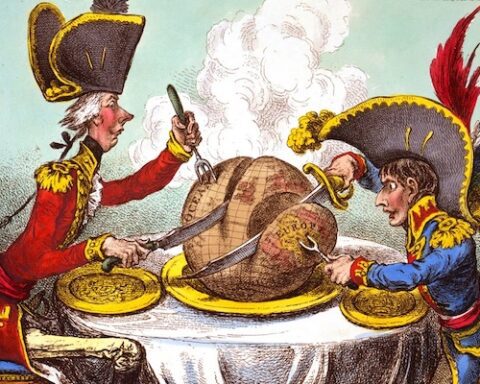
Richelieu understood that states endure by paying others to bleed. Metternich preserved balance by financing foreign force. Bismarck unified Germany by ensuring Prussian blood was spent only after others had softened the field. They understood that strategy is not heroic. It is economised violence. Sovereignty is not the refusal to outsource violence. Sovereignty is the ability to outsource it effectively.
The American contract expired not through betrayal, but because its electorate and its strategic priorities have shifted elsewhere. Europe must now either fight its own wars or hire them out.
Even Berlin has acknowledged the rupture. General Christian Freuding, the German officer responsible for coordinating support to Ukraine, now speaks openly of severed communication lines with Washington. Decisions once shared “day and night” are now taken unannounced, and allies learn of them only after the fact. In strategic terms, this is not alliance. It is liability.
Resilience alone is not defence. A nation that merely repairs damage teaches its attacker what to break next. I have listened to European security officials congratulate themselves for restoring sabotaged systems “within forty minutes.” A rapid repair is not deterrence. A defence that does not make its attacker pay is not strategy. It is maintenance. Russia must not be endured. It must be contained, constrained, and made to pay, financially, militarily, territorially. Already morally bankrupt long before it became militarily reckless, it must be bankrupted in practice.
Ukraine is not charity. It is the purchase of a frontier. If Russia is decisively defeated, territory can be reconfigured into a perimeter of states, some already existing, others yet to be carved from geography not politically awake, and weaponised for European stability. This is not a moral project. It is the economics of power.
Europe’s future is therefore not to send its own sons to die, but to arm and sustain a ring of states whose existence produces our security. We will describe this in the language of solidarity, reconstruction, and values. But the truth beneath the rhetoric is simple: Europe must strategically outsource violence to preserve its civilization.
Europe does not invest in Ukraine out of affection for its liberty, but because abandoning it would bankrupt us; it does not uphold Ukrainian sovereignty as an ideal, but purchases time, territory, and expendable bodies we can no longer provide ourselves; it does not defend democracy as a virtue, but sustains its civilisation by subsidising violence beyond its borders. If Europe wishes to enjoy peace without bleeding for it, then it must embrace the truth it pretends not to know: peace is a transaction, its currency is blood, and the only decision left is whose.
The question is not whether Europe wants peace.
The question is: who is permitted to buy it?
No civilisation survives because its citizens understand its requirements. It survives because a small number of people are willing to carry them out without asking permission. This policy of purchased borders belongs not in public debate, but in the Council of the European Union’s Foreign Affairs configuration, the NATO Parliamentary Assembly, and the offices of national defence ministers, where budgets are negotiated like treaties and treaties treated like weapons.
The public will call it solidarity. The negotiators must treat it as arithmetic.
What must be decided in private will later be celebrated in public as principle. Strategy always begins as something that cannot be said aloud.
John Sjoholm, for LIMA CHARLIE WORLD
[Subscribe to our newsletter for free and be the first to get Lima Charlie World updates delivered right to your inbox.]
John Sjoholm is Lima Charlie’s Middle East Bureau Chief, Managing Editor, and founder of the consulting firm Erudite Group. A seasoned expert on the Middle East, North Africa, Europe and the Balkans, he has a background in security contracting and has served as a geopolitical advisor to regional leaders. He was educated in religion and languages in Sana’a, Yemen, and Cairo, Egypt, and has lived in the region since 2005, contributing to numerous Western-supported stabilisation projects. He currently resides in Jordan.
Offline References:
[1] https://www.forsvarsmakten.se/…/nato-utnamner…/
[2] https://www.foi.se/…/2025-12-03-barn-till-utlandsfodda…
[3] https://www.foi.se/…/2025-11-10-varnpliktiga-gar-miste…
[4] https://www.euronews.com/…/over-two-thirds-of-europeans…
[5] https://www.researchgate.net/…/398136837_Europe’s…
[6] https://euromaidanpress.com/…/backing-ukraine-costs…/
[7] https://www.theatlantic.com/…/german-militarism…/684951/
Lima Charlie World provides global news, featuring insight & analysis by military veterans, intelligence professionals and foreign policy experts Worldwide.
For up-to-date news, please follow us on twitter at @LimaCharlieNews
In case you missed it: